







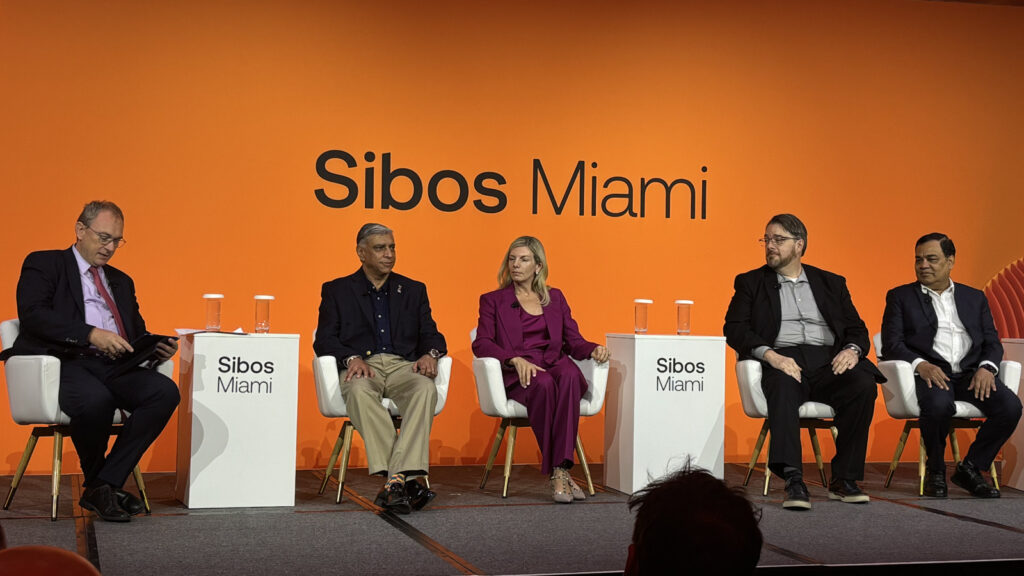
Fraudsters are increasingly turning AI into a tool for deception, from convincing deepfakes to highly targeted social engineering. For financial institutions, that is changing the nature of the trust challenge: the technologies used to strengthen security are also becoming available to those trying to bypass it. At Sibos 2026 in Miami, the panel Deepfakes at the door: keeping finance secure in the age of AI examined how banks are responding to that shift and whether they can keep pace with increasingly sophisticated attacks.
“Fraud has always come fast,” said Diana Rothfuss, director, Global Risk, Fraud and Compliance Solutions at SAS. “AI has not only just made it faster, but made it a lot harder.”
Moderator Olivier Denecker, senior advisor at Projective Group, pointed to a fundamental shift in the nature of fraud. Instead of simply stealing credentials, criminals can now manipulate people into authorising transactions themselves.

“Fraud for a long time was based on stealing passwords and access to systems,” he said. “Nowadays it’s about stealing the identity of both the person that could receive a payment but also make a payment.”
Human oversight
The challenge is not purely technological. While AI can help identify suspicious behaviour, the panellists repeatedly returned to the importance of human oversight, governance and procedures.
Rothfuss argued that “human in the loop” remains essential, particularly when AI-generated alerts or decisions need to be assessed by people. “AI is only as good as you can make it within your own organisation,” she said.
That also means accepting some friction. Additional authentication, callbacks and transaction checks can make payments less seamless, but Sundar Sundararajan, CEO and founder of i-exceed technology solutions, argued that this may be necessary as fraud risks increase.
“The friction becomes essential,” he said.
The panel also stressed that financial institutions cannot tackle the problem alone. Kamlesh Harry, strategic advisor Fraud & Fincrime at Nasdaq, called for greater information sharing between institutions. “A network of criminals operate in that sense, in a network. Unfortunately, financial institutions don’t operate as a network today,” he said.
As AI accelerates both attacks and defences, the message from the panellists at Sibos was clear: staying ahead will require continuous innovation, stronger cooperation and humans remaining part of the decision-making process.