


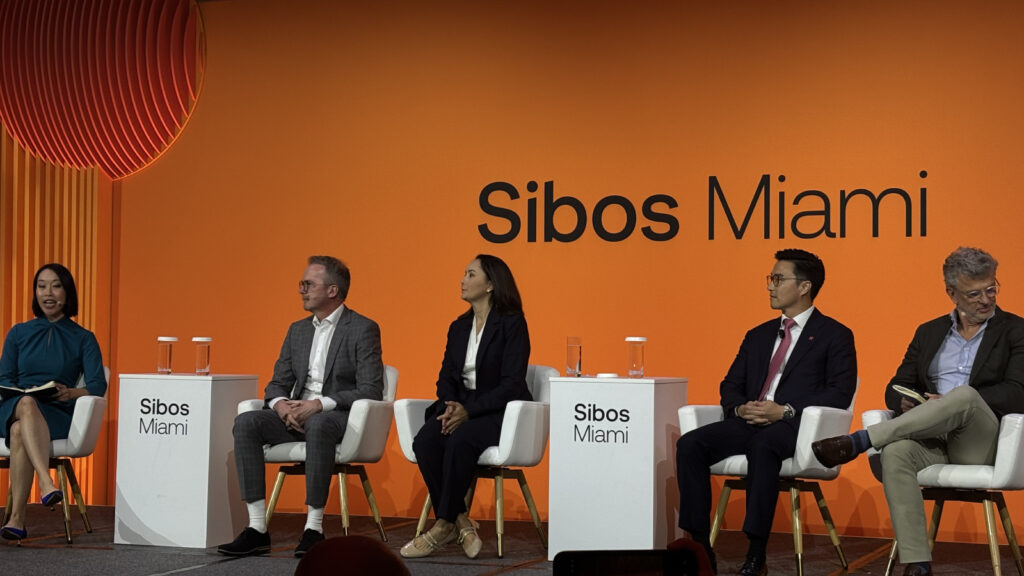
Talk of de-dollarisation is becoming increasingly common, but the US dollar remains deeply embedded in global reserves, trade and settlement. At Sibos 2026 in Miami, panellists explored where diversification is actually happening and what could accelerate it.
Dirk Bullmann, CEO of CLS Group, drew a distinction between reserves and settlement. The dollar’s share of global reserves has fallen from around 71–72% two decades ago to 57%, he noted. In FX settlement, however, the picture is different.
“In the settlement space, we don’t see de-dollarisation happening,” Bullmann said, pointing to the dollar’s continued dominance in FX trading.

Other currencies
Other currencies are gaining ground in specific corridors. Simon Ong, head of FIG at DBS Bank, said Asian trade is increasingly being denominated in local currencies, while alternative payment rails are emerging alongside established infrastructure.
He described the dollar and SWIFT as the “highway” for global payments, with new local-currency and real-time payment systems emerging as “side roads”.
For Mali Bartlett, global head of Liquidity & Account Solutions at J.P. Morgan, the biggest challenge is connecting those systems. “The biggest pain point is the interoperability,” she said, highlighting the need to connect domestic and cross-border payment rails while avoiding fragmented liquidity.
Expressway
Technology could further reshape the landscape. CEO of Actinver Julio Cardenas pointed to tokenisation’s potential to improve traceability and efficiency, while Bullmann warned that innovation must not undermine confidence. “We have to make sure that we move at the right pace in order to make sure that trust is not lost,” he said.
The result may be a more diversified payments landscape rather than a straightforward move away from the dollar. As Ong put it, diversification is increasing, but “the expressway remains.”
Sibos 2026 plays out in Miami from 28 September to 1 October. We are there, view our coverage here.