



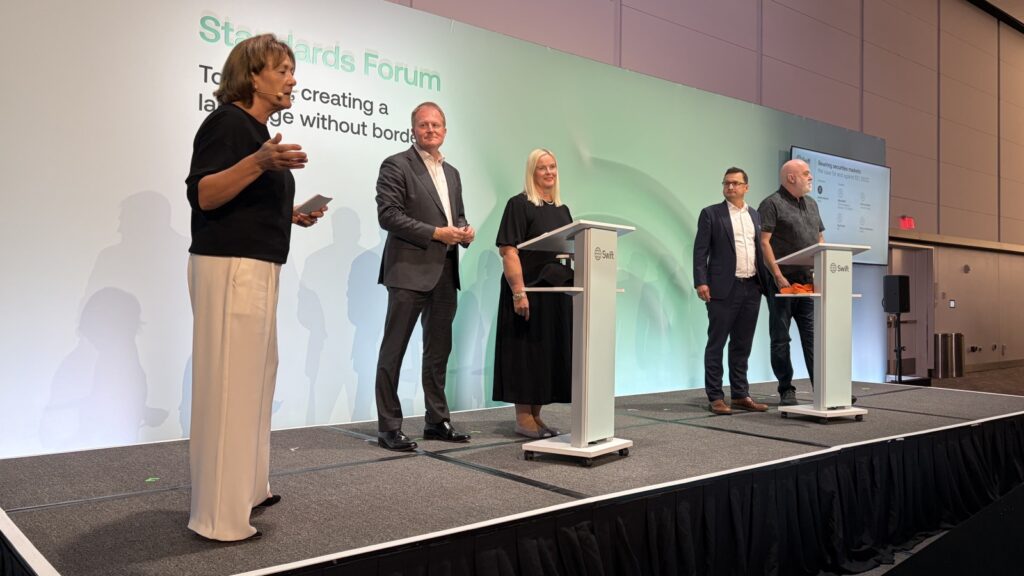
To fight the post-lunch lull, the session titled “Rewiring securities markets: the case for and against ISO 20022” at Sibos 2026 introduced a lively debate. The results were clear: everyone – even the speakers assigned to play the opposition – were in favour of the messaging standard.
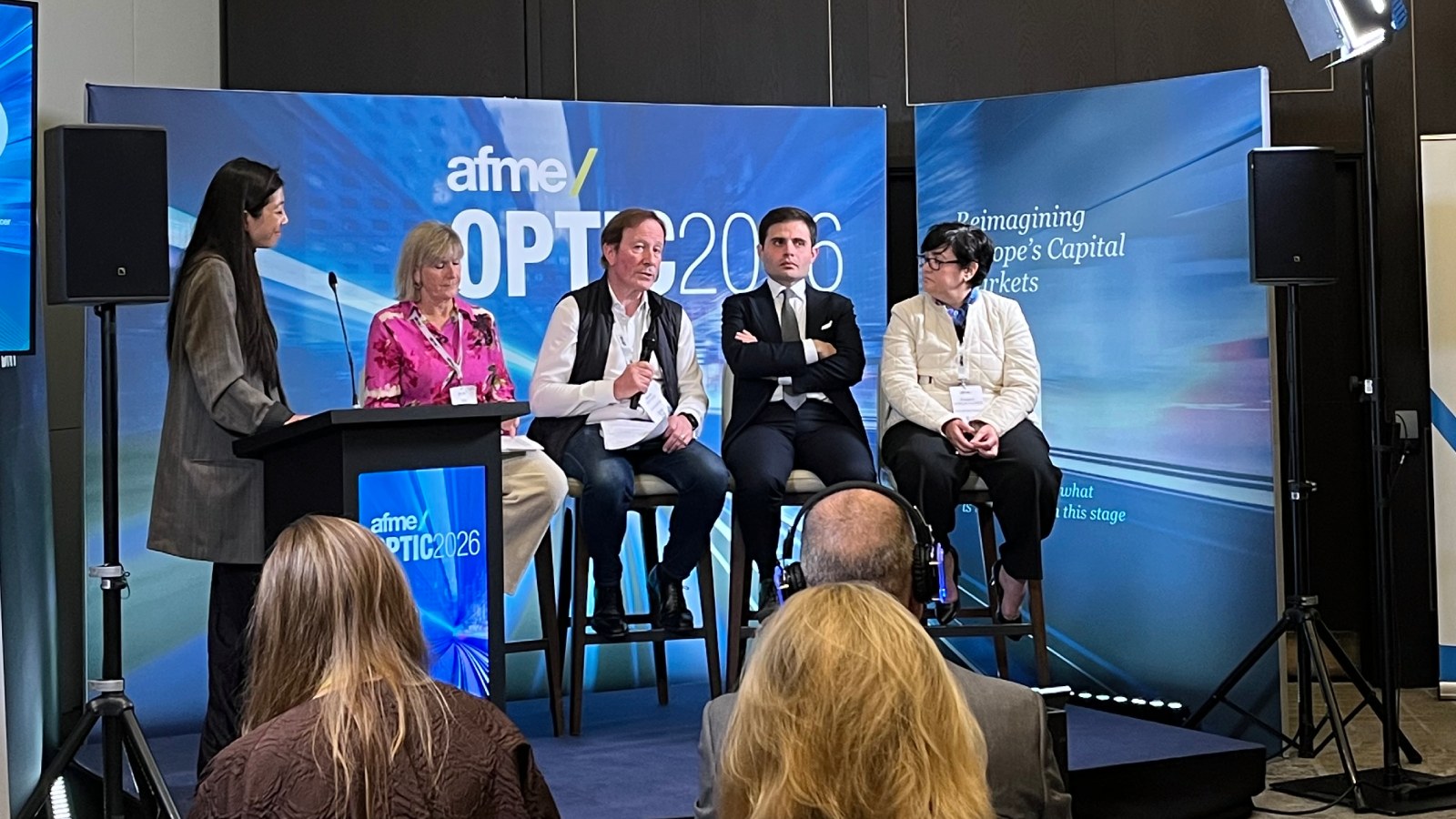
Juliette Kennel, global head of Industry Engagement, Securities and Standards at Swift, set the stage by introducing both sides. Paul Fullam, business solutions consultant at FIS, and Marcin Zawistowski, principal expert at Polish CSD KDPW, were the proposition. Playing the opposition were Emma Johnson, head of Industry Relations and Advocacy at The ValueExchange, and Giles Elliott, industry advisor of Capital Markets Tata Consultancy Services at TCS BaNCS.
Zawistowski opened the debate. “We need to create a language, a single language without borders, and the only available language today that could fulfill this promise is ISO 20022.”

His teammate Fullam jumped in with a supporting argument. “When you look at Bitcoin and digital assets, just the decimal places that are needed to represent those fractional units of a Bitcoin, it can’t be done in 15022. It can only be done in 20022. From that standpoint alone, it’s worth migrating.”
For Fullam, the superior functionality of ISO 20022 is reason enough to eliminate ISO 15022. “You have to remember that the destination was never coexistence. The destination was 20022,” he reminds the audience.
Dollars and cents
Johnson brought up a point that was difficult to refute: money. “We don’t feel there’s a clear business case and certainly not a comparable business case to the one that drove the payments industries’ migration to ISO 20022 over many years.”
“Where should precious and finite budgets be spent? Protecting the ecosystem and investors against cyber and sanction risk and fraud, implementing complex multi-year regulatory changes, including T+1, or investing billions – and it will be billions – into migrating messaging standards for an incomparably more complex suite of messages than payments across a deeper ecosystem for unproven business benefits?” she asks.
Addressing Fullam’s point about coexistence, she says, “The cost of coexistence is a difficult one to quantify, but also to eliminate… In 2023, it was estimated that European banks spent approximately US$100 billion preparing for ISO 20022. That was three years back, and it was for the payments sector. The scale and breadth for securities will realistically be more. Nearly 50% of central banks to date have yet to adopt ISO 20022 messaging for their payment transactions. The uptake was hindered by unclear return on investment and that still rings true today.”
Elliott supported Johnson’s argument by sharing his personal experience from working with the International Securities Services Association (ISSA). “We spent a fair amount of time talking to the major banks and asked, ‘Are you really going to save money if we take one of these standards away?’ Really, the absolute reply that we got and the clear feedback was, they are already managing multiple standards, and it’s very hard to figure out a cost that they would eliminate from doing it.”
Only a united front
Fullam reminded the audience of the big picture – the original intention of implementing a new messaging standard. “ISO 20022 was created for flexibility, to enable an easier way to transfer data that can be read via application programming interfaces (APIs). When you look at XML – and we know the ‘X’ stands for extensible markup language – ISO 15022 does not give you that capability.”
Elliott conceded, saying, “There’s no arguing against the fact that there’s hugely more definition in the data dictionary and how we break down components within 20022… From one angle, that will reduce fragmentation and the use of free format text within messages.”
But it is not a flawless system. “The other side of that is we have things called extensions, which are incredibly useful, but actually cause fragmentation. They are useful if you are a CSD trying to push forward an agenda and you don’t want to wait for global consensus around that. You can use that to make sure that under your own steam, under your own business case, you can move forward. That’s useful, but it causes a downstream problem. And the downstream problem that I think we have at the moment is that there is no consensus across the world about how everyone upgrades to a common version and how we take the extensions out and put them into the core.”
Johnson agrees, “More markets doing their own version of standardisation is functionally more fragmentation.”
Single truth
To conclude the debate, the speakers shared their honest opinions, revealing that no one was truly against the adoption of ISO 20022.
Elliott suggested that a more laissez-faire attitude might be beneficial. “I think our industry knows what the use cases they want to spend money on are. Rather than us top down and holistically saying let’s just go after it… I firmly believe that the leading players and custodians of the market will actually start moving to ISO 20022 because they’re thinking very strategically about the future. And it’s not about settling a trade better. It’s about what they want the client experience and the risk management practices to be in five years’ time.”
Johnson concludes, “We cannot create a new world with 100 different versions of the truth. There needs to be one.”
Sibos 2026 plays out in Miami from 28 September to 1 October. We are there, view our coverage here.