



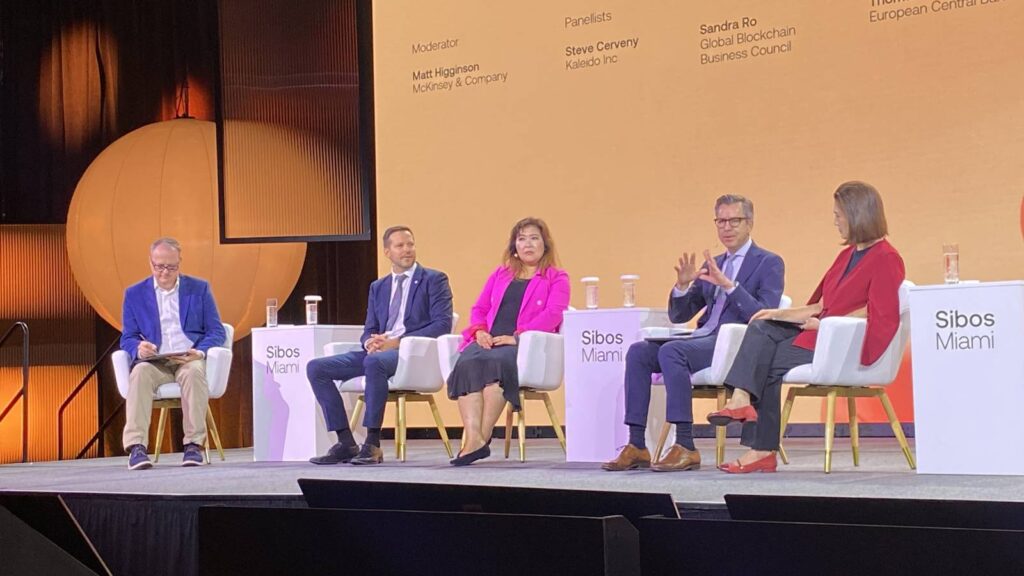
As tokenisation leaves the “death by PoC” era behind, a Sibos panel of central bankers, bankers, technologists and industry advocates asked who answers to the client when something goes wrong – and where trust in tokenised markets will really come from.
If we move fast, someone is going to move faster. That warning from Ee Fong Alice Soh, group head of Securities & Fiduciary Services at DBS Bank, set the tone for a day-three Sibos panel that spent less time on blockchains than on people.
Soh described how DBS has deliberately put friction back into the customer journey. Clients can “vault” cash digitally, but to withdraw it they must visit a branch. New payees trigger a 12-to-24-hour wait. “We’ve always talked about STP, straight-through processing, but now we are creating friction so that people have a time to actually just step back,” she said. In one case, a husband stood behind his wife at the counter signalling to the teller that she was falling for a scam; staff took her aside and calmed her down.

It was a pointed reminder that trust is built where an institution faces its client – and that is where the tokenisation debate now sits. With live platforms replacing pilots, the question is no longer whether the technology works, but who answers to the client when it does not, and how that accountability creates the value needed to scale.
Policymakers are heading the same way. The IMF has argued that as tokenised markets develop, accountability is likely to shift away from infrastructure operators towards issuers, exchanges and service providers. The SEC’s broker-dealer custody guidance puts the burden on the firm rather than the technology: before custodying a tokenised security, a broker-dealer must assess the blockchain’s operational integrity and document that assessment.
So where will trust come from? The panel, moderated by Matt Higginson, Distinguished Partner at McKinsey & Company, set out to answer that.
Rules, governance and settlement assets
Thomas Vlassopoulos, Director General, Market Infrastructure and Payments at the European Central Bank, said trust in a tokenised world rests on the same three layers as today: rules, governance and settlement assets.
On rules, investors need certainty over their ownership rights to the value a token represents, and those rights must be enforceable. Yet it is not always clear whether securities legislation carries over fully when an asset is tokenised. Settlement finality on networks using probabilistic settlement also needs legal recognition. And because tokenisation unbundles services such as issuance, custody and asset servicing, regulation must shift “from the entity to the services themselves” – the direction taken by the EU’s DLT Pilot Regime.
On governance, he was blunt. “Things can go wrong, but then people need to know who can be held accountable.” That includes governance of smart contract code – validation, change management and, in a crisis, who has the authority to pull the “kill switch”.
Steve Cerveny, CEO of Kaleido, noted that Project Agorá has one tech team but eight legal teams; its legal papers run to 340 pages against 80 for the technical one – a measure of where the hard work lies. Shared ledgers also pose a “have your cake and eat it too” problem, he said: the efficiency of shared data while respecting the privacy of individual transactions.
Friction versus efficiency
Sandra Ro, CEO of the Global Blockchain Business Council, said the industry must balance consumer-protection friction against the efficiencies it wants in settlement and payments. “That balance is the difficult part. It’s the messy part.” Higginson offered one resolution: efficiency in the back office, physical frictions at the consumer front.
Ro also urged attention to detail, citing a New York Department of Financial Services consultation on GENIUS Act rules that asked whether an intraday mismatch caused by end-of-day batch bookkeeping should count as a stablecoin shortfall.
The end of “death by PoC”
Cerveny said the industry is finally leaving the “death by PoC era”, pointing to Swift’s ledger and the Eurosystem’s Pontes as production implementations, with many more market infrastructures due online in the next six to 12 months. The next job is connecting them. For interoperability, institutions prefer the “trusted bridge” model, in which an operator has specific responsibility for managing the link, over trustless bridges – “the ones you hear about getting hacked all the time”.
Both he and Vlassopoulos stressed the cash leg. Not everything needs to settle in central bank money, Vlassopoulos said, “but the convertibility of private settlement assets into central bank money is what ultimately gives trust and confidence”.
Who is accountable?
Pressed on who is accountable across multiple chains and synchronisation layers, Soh was unequivocal. “If I put the client at the centre of it, I’m accountable to the client.” DBS runs a closed network today, but as platforms open up, she said, the community must work together to ensure “the walls around this community” stay solid against scammers.
Ro said the narrative is moving from “which blockchain’s fault is it” to “who is the provider to the customer” – and what standards and enterprise-grade metrics that regulated institution applies to every third party it chooses, blockchains included.
Where trust will come from
Asked for a final word, Cerveny hoped the rails would “fade into the background” as attention turns to client value. Soh said trust “comes from the client and it doesn’t matter what the plumbing is at the back”. Vlassopoulos chose “anchor” – central bank money as the trusted medium between institutions. Ro looked further ahead: today trust rests on humans; tomorrow, “if we do it right”, some of it may be delegated to AI agents.
Higginson’s summary was a good set of common rules, customer-facing institutions owning accountability, and humans kept firmly in the loop. Trust, in other words, is not about the tech.