









DEEP LOOK | Accelerated settlement, geopolitical risk, cyberthreats, digital assets convergence — the pressures reshaping post-trade’s next five years are pulling in different directions. PostTrade 360’s Stockholm conference asked whether the industry can have speed, safety and synergy, as firms rethink planning, plumbing and pace for a riskier, more interconnected world.
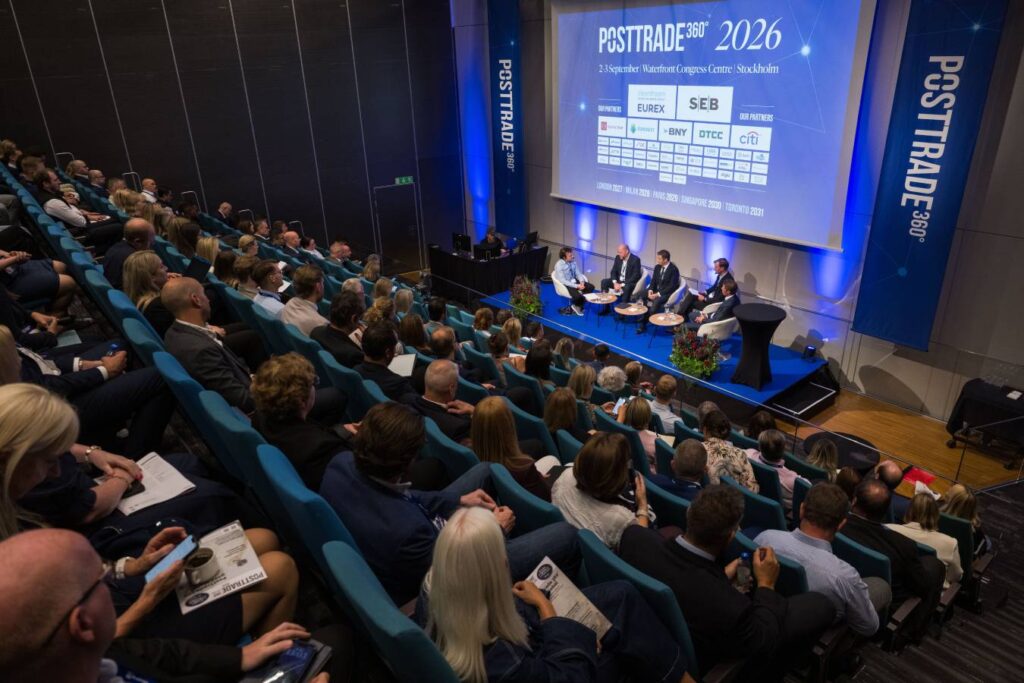
Fittingly, the event was staged on Stockholm’s waterfront—a fitting backdrop for a conference whose audience keeps widening. As that audience has become increasingly global, so has the conversation: firms are no longer weighing speed, safety and synergy as domestic concerns but as forces that cross borders as fast as capital does. It’s one reason the show moves to London next year, keeping pace with an audience that’s going global.
Sweden itself is pairing ambition with broader standardisation and collaboration. While preparing for Europe’s T+1 deadline of 11 October 2027, it’s also joining T2S in 2030, and its central securities depository — along with Finland, Denmark and Norway — will morph into one Nordic issuer CSD, enabling issuers and investors to connect and settle securities across the region, Hanna Vainio, CEO of Euroclear Nordics, announced at the event.

That convergence set the tone for the two days and beyond: collaboration, navigating geopolitics and risk resilience, an accelerating always-on world, and the standards needed to prove tokenisation at scale.
Geopolitical uncertainty: FMI resilience and systemic risk
As financial market infrastructures (FMIs) take on a growing role as risk buffers in a faster-moving system, geopolitics and cyberthreats have shifted from incidental to adversarial—and resilience now depends on communication and collaboration between increasingly connected players.
During a geopolitics and post-trade session Valentino Wotton, global head of Equities Solutions at DTCC, described the balance FMIs must strike across T+1, 24/5 and 24/7 trading, in both traditional and digital markets: “the responsibility with FMIs [is] the greatest it’s ever been.” He added: “We used to look at things more as isolated events from a risk perspective, but now it all has to be through an interconnected lens. One action creates a reaction, and all that keeps going.” Watch session
Mark Gem, chair of the Risk Committee at Clearstream, described how the Russia-Ukraine war shifted post-trade’s relationship with politics: “the politicians have learned we exist and it’s a powerful instrument.” That, he argued, undermines FMIs’ ability to position themselves as neutral infrastructure insulated from political turmoil.
With uncertainty now baked into the post-trade fabric, prediction models alone won’t suffice. Christophe Diederen, head of the Macroeconomics Centre of Excellence at Euroclear, offered an alternative: “I don’t think we should be trying to predict what the world will be like… but instead try to identify a set of plausible futures and make sure your plans, decisions and strategies are reasonably robust across [them].”
Post-trade as the capital markets’ engine room
AI in post-trade is no longer just an efficiency story. It’s creating real process gains, but it’s also drawing political and regulatory attention — the Bank of England recently warned that frontier AI risks are transforming the cyber-threat environment and could put the global financial system at risk.
At the same time, firms are starting to see AI’s role beyond cost-cutting. Panelists during a session on the forces shaping post trade enthused about this trajectory. Sebastien Danloy, chief business officer at Euroclear, described a shift from an automation mindset to a revenue mindset, with client demand pushing AI use beyond disputes and reconciliation into new products and services. Watch session
Sam Riley, CEO of Clearstream Securities Services, pointed to a further shift: the reuse and industrialisation of data attached to programmable securities as a “golden source” that’s transferable across both asset and data layers. “This is what we mean by hybrid: developing an architecture and infrastructure that allows both models to coexist while creating real value for clients.”
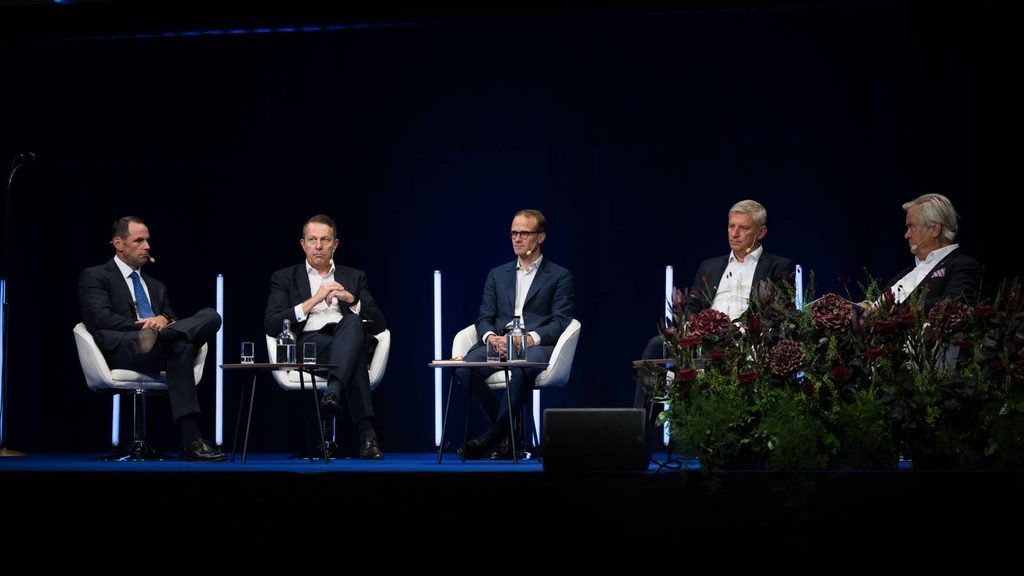
Caption: A discussion about the forces shaping post trade through 2027 and beyond. L-R: Brian Steele, DTCC; Sam Riley, Clearstream; Pierre Davoust, Euronext; Sebastien Danloy, Euroclear and Goran Fors, SEB (Photo : Suvad Mrkonjic Fotografiska AB)
“I don’t like the word plumbing to describe post-trade”
As the EU’s Market Integration and Supervisory Package (MISP) moves through its final stages, Klaus Löber, chair of ESMA’s CCP Supervisory Committee, pushed back on the industry’s favourite metaphor — plumbing, “only noticed when something breaks”—in favour of something with more agency: “It is about dynamic networks of trust. It’s about managing, allocating risks… it is actually the core of the financial markets.”
He set out four regulatory concerns: tokenisation’s fit with settlement finality and centralised risk management; the fragility created by compressed settlement timelines; cyber and operational risk; and the concentration risk of FMIs increasingly dependent on a small pool of cloud, data and AI vendors. “Regulators cannot act in isolation,” he said — the answer isn’t to abandon cross-border cooperation, but to make it more practical and honest about dependencies.
The future of custody, settlement and clearing
A discussion with the ISSA board showed collaboration in action. Margaret Harwood-Jones, CEO, Europe and UK, for Standard Chartered, argued that faster settlement cycles and AI mean firms can no longer treat product, tech, ops, risk, governance and compliance as separate workstreams—the operating model needs rebuilding end-to-end. On digital assets, she was clear it’s a long-term structural shift, not a niche product: “the traditional and the digital world will coexist for a very long time.” Watch session
Philip Brown, global RM & Sales, Clearstream Securities Services grounded that in a live example: a major institutional-debt issuer now wants to go direct-to-retail via digital rails, with crypto-native platforms — not traditional custodians — as the distribution point. “It’s going to be the Krakens, and Revoluts, and BitPandas of this world. It’s not going to be our traditional clients.” He also argued that geopolitical risk management has shifted from episodic to structural: “That’s no longer a tail event, it’s kind of become part of our operating environment.”
Chris Rowland, head of custody, digital and fund services product, at State Street reframed the AI-and-headcount conversation: “It isn’t just about how many human beings we take out because human beings are expensive. It’s about how you start to redeploy those people.” He argued AI is commoditising expertise itself, and that the skills the industry now needs — “taste, judgement, discernment” — aren’t yet what it’s hiring or training for. The differentiator won’t be the technology itself but the critical thinking and design skills needed to harness it — and to de-risk something that, at its core, is still just that: artificial. This point was expanded during a session titled “The human element”. Watch session
On accelerated settlement, DTCC’s Brian Steele, president, Clearing and Securities Services, offered the clearest reality check of the conference. He called the direction of travel “inevitable,” but laid out the capital constraint bluntly: “It’s nearly a trillion and a half more capital… every day that’s required to continue to operate the exact same activity… there’s just not enough capital in the world for that to exist.” His reframe: less a hard cutover to T+0, more “settlement as required,” driven by customer choice.
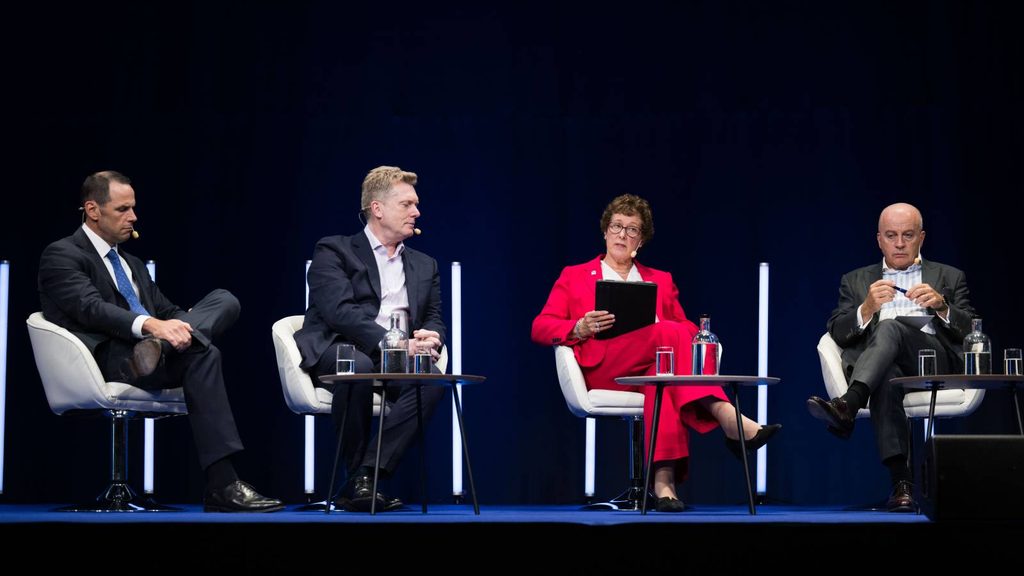
Caption: A discussion with the ISSA board. L-R: Brian Steele DTCC; Chris Rowland, State Street; Margaret Harwood-Jones, Standard Chartered; Philip Brown, Clearstream (Photo : Suvad Mrkonjic Fotografiska AB)
Clearing and the battle for client share
With the US already on T+1, attention is turning to 24-by-5 trading and clearing. NSCC went live on this basis on 28 June, now operating from Sunday evening through Friday evening, largely to serve Asian retail activity. “At LCH, this means integrating the additional flow into our systems and upgrading our risk management processes,” said James Stacey, COO of EquityClear, LCH during an equities clearing session — who also noted that full interoperability carries costs well beyond margin: the complexity of building networks, engaging regulators, and putting operational agreements in place. Watch session
Pablo Garcia, Associate Director for Post-Trade at AFME, argued interoperability shouldn’t be treated as one-size-fits-all, given the margin and exposure challenges it raises across clearing houses — but that the expected risk reduction from T+1 could be an opportunity to revisit margin requirements. On MISP: “a step in the right direction, but regulatory support will be needed to drive meaningful change.” Erik Veerman, senior consultant market infrastructures at ABN Amro, speaking on a later panel on the implications of MISP for FMIs and market participants, underlined the scale of that challenge — MISP spans roughly 500 pages, touches 90 trading venues, 14 CCPs and up to 34 CSDs, and had attracted some 1,900 amendments by the time of the conference. He also pointed to a number that had stuck with him from an earlier ECB conference: Europe currently has 52 supervisors across the union, a fragmentation he argued makes consistent clearing risk management especially hard to achieve. Watch session
The future of money, 24/7
As tokenisation scales, network fragmentation is becoming a shared cost across both traditional and decentralised worlds. Replicating the connectivity of an established network like SWIFT—more than 11,000 members across 200 countries—isn’t straightforward, and the more blockchains firms connect to, the greater the cost and complexity.
Ryan Rugg, global head of Digital Assets Services at Citi, pointed to Citi Token Services, which lets clients move cash 24/7 on a private, permissioned version of Ethereum: transaction volumes have grown from millions to billions daily. “If interoperability were not important, we would not be using blockchain.”
Lucy Snowball, digital asset product manager at BNY, argued asset servicing — corporate actions especially — is the area most at risk of being left behind: “If we do not get asset servicing right, we will not be set up for the future of digital and traditional assets.” Standardisation, panellists agreed, is what will let the industry scale: without common standards for trade date, settlement date, record date and payment date, “we risk spending another decade or two fixing the problem,” said Christine Strandberg of SEB.
Ensuring always-on markets don’t lead to always-off funding
As markets edge toward continuous trading, the funding ecosystem underneath them is still running on fixed schedules — and the mismatch is starting to bite. “Clients are not asking for 24/7 markets for the sake of 24/7 markets,” said Rebecca Bridgeman, director of the Global Collateral Platform at BNY. “They’re really coming to us with the challenge of liquidity access and funding flexibility.”
The shift to T+1 in the US and Canada was instructive, she said, highlighting the need for better intraday liquidity tools and intraday repo. In Europe, with its patchwork of currencies and market practices, the tolerance for collateral sitting in the wrong place — or arriving too late in the day — is only shrinking. BNY plans to extend its settlement window for US Treasuries to 18 hours a day, five days a week, by the end of this year.
T+1: readiness and automation for €100 a month
With just over a year until Europe moves to T+1, a session found 83% of firms are now actively working on it, with planning having doubled in six months — 58% are implementing, not just drafting. Giovanni Sabatini, chair of the EU T+1 Industry Committee, was unequivocal: “Automation, automation, automation is the mantra.” Manual and non-standardised processes, he said, are simply incompatible with the time compression T+1 demands — and the deadline isn’t next year, but now, with ESMA’s December 2027 requirement for same-day allocation and confirmation looming behind it.
Valentino Wotton laid out the scale of the challenge — DTCC processes 2.5 million allocations daily, with over 18 million standing settlement instructions on its books — while pushing back on the idea that automation is expensive: “We launched an automation package, which is 100 euros a month. That’s it.” Among firms using automated platforms, 98% of equity transactions and 94% of fixed income transactions are now allocated and confirmed same-day, with Sweden leading at 99%. T2S is also rolling out a new “gating event” function to help synchronise repo legs through the T+1 transition.
Pete Tomlinson, representing AFME, brought the user-side view into focus, pressing on where cost and competition pressures are actually landing across securities services and payments Watch session
What’s still missing is a clear-eyed answer on cost: nobody yet has a firm handle on how much fragmentation—across CCPs, blockchains, or the 52 supervisors overseeing EU markets—will actually cost to fix, or whether the value tokenisation and interoperability unlock will offset it. For infrastructure users weighing where to put scarce attention and budget across safety, synergy and speed, that’s the open question Stockholm laid bare.