









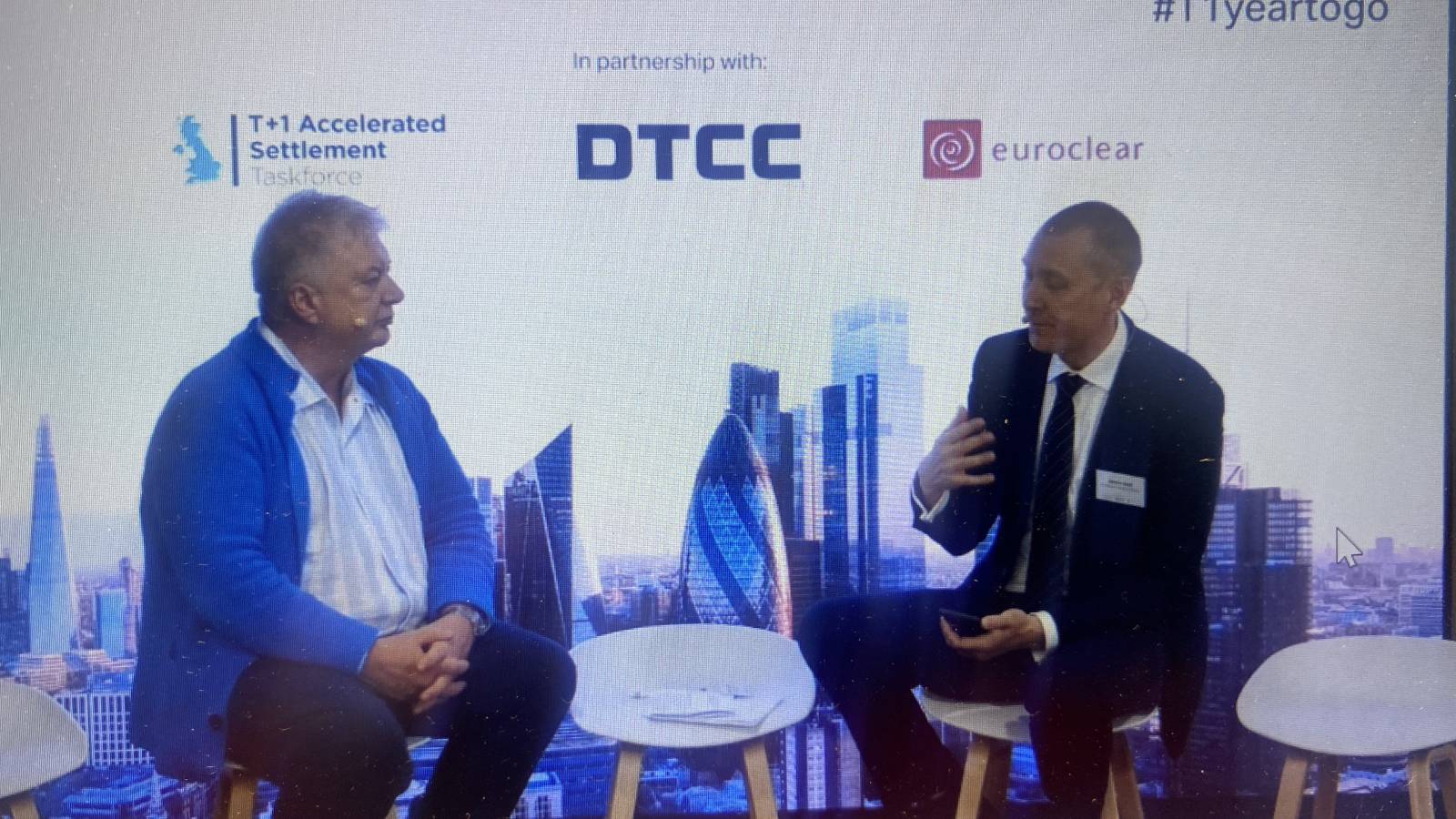


INTERVIEW – HANNA VAINIO | Mark your calendars for Q2 of 2030; that’s when Sweden will transition to TARGET2-Securities (T2S), the pan-European securities settlement system. Contrary to previous estimates, the move will now happen closer to the implementation of TARGET2 (T2), the real-time-gross-settlement (RTGS) system for payments, and without an interim local solution. We caught up with Hanna Vainio, CEO of Euroclear Nordics, at Sibos 2025 for a deeper look at the change.
Sweden’s stretch to a decisive deadline for T2S transition has been a long one. On 18 June last year, Riksbanken, the country’s central bank, announced its decision to join T2 in 2029. No similar commitment was given for T2S except that it was going to happen after T2 – an outcome in line with the wishes expressed by most market participants during the consultation phase.
In an interview with PostTrade 360° in 2024, Christine Strandberg, head of Investor Services Banks Product Management at SEB, revealed that most stakeholders would prefer to have two years between the implementations of T2 and T2S to allow for testing within the securities market. Going back further to 2023, at the PostTrade 360° Stockholm conference, Ann-Kristin Fessé, Euroclear’s head of Commercial Financial Institutions, suggested that the T2S transition could take 10 years, which put her estimate at 2033.

Sooner, rather than later
These timelines changed when Vainio came on board as the CEO of Euroclear Sweden in January this year, in addition to her role as CEO of Euroclear Finland. Now the head of two Nordic divisions, she has her sights set on creating a broader strategy that encompasses the two markets.
“We are no longer looking at a purely local strategy,” she says. “From a Nordic perspective, Sweden and Finland have many commonalities compared to some other central European markets.” Case in point, Vainio revealed that Euroclear Sweden and Euroclear Finland share 13 clients in the Nordic market. These customers account for 90 per cent of the asset value in Euroclear Sweden.
Vainio’s valuable experience from Finland’s 2023 T2S transition, which by all accounts, went without a hitch, gave her the confidence to push for an earlier T2S transition for Sweden. In May this year, the idea of an interim local settlement platform was dropped with “unanimous” client support. Instead, Sweden will transition directly to T2S in Q2 of 2030, shortly after the expected transition to T2 for payments. Vainio unveiled the decision at the PostTrade 360° 2025 conference in September.
“We are looking at the needs of the Swedish market, which has been more and more about European standards – harmonised standards – and the adoption of those in the Swedish market,” says Vainio.
Shorter stretch to success
Sweden will have the advantage of leaning on Finland’s success with T2S, using the same system that is already established in Finland as a foundation that can be adapted to the needs of the Swedish market. Euroclear has assessed the functions of the Finnish platform for their feasibility of use in the Swedish market and concluded that the reusability rate is above 90 per cent. “It’s a wonderful starting point,” Vainio enthuses.
“T2 is happening, so there’s a natural evolution that T2S will come as well,” she says. Because the platform – fully compliant with standards such as ISO messages in place – is already in production, Euroclear is confident that it is “in a position to open test environments for clients early on”. Vainio floated the summer of 2027 as a potential launch date for testing, but emphasised that it has yet to be confirmed.
She assured us that the shorter timeline for transition is not necessarily a disadvantage to smaller market participants. The key is agility. “At times, the smaller players have a more linear IT set-up and are, maybe, a little more advanced – these are my words, not anybody else’s. Big banks have legacies and programmes that might be quite heavy.”
All involved
Next on the agenda for Vainio are negotiations; the coming year is expected to involve many talks – with both the European Central Bank (ECB) and the community. “You need to agree on testing times, migration rehearsals, and all of that. It’s a procedure,” she explains, revealing that nothing is expected to be finalised before 2027. “It’s a process we have to follow, but for me, it’s about keeping the pace, getting this done, getting the market ready, and delivering quality.”