
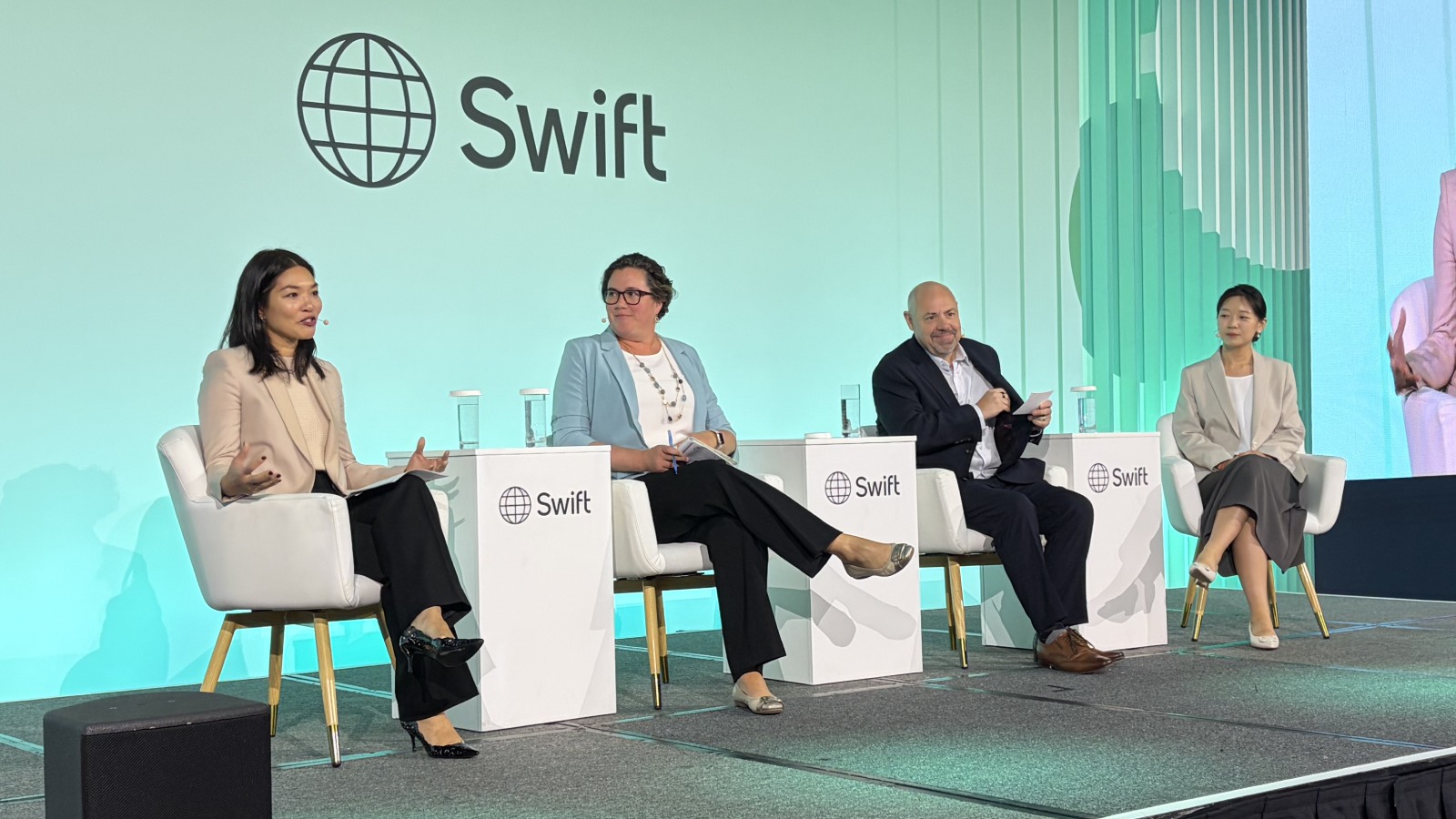











Settlement risk isn’t about failed trades at the end of the process; “it’s really about the uncertainty that has been building along the way”. Introducing the panel titled “Closing the gap: practical approaches to settlement risk” at Sibos 2026 with this succinct description of the topic, Tracy Chou, senior securities expert at Swift, led three other experts in a discussion about managing settlement exposure.
According to Chou, here’s how the potential for settlement risk snowballs: “A trade is executed in one market, investors are in another market, the custodians are in a third, while the cash is still flowing through a different time zone. Each participant has a different system and different identifiers, and they can only see part of the story. The common theme is that everyone’s rushing against time.”
Compress it all into a T+1 environment and we are “simply making the blind spots arrive faster”.

As if that isn’t challenging enough, Kevin Blair, global head of Securities Services at Northern Trust, believes that T+1 “isn’t the end goal”, but is only “a stepping stone to T0”. While T+1 is achievable “through automation and accelerating some of the manual processes”, T0 will require an overhaul of the market infrastructure. There is therefore, “a lot to overcome”.
The persistence of settlement risk isn’t for lack of trying. Chou pointed out that across the industry, much effort has been put into standards, automation, and harmonisation – sometimes, it seems like systems simply “don’t talk to each other, even within an organisation”.
Aundrea Jarvis, managing director at Brown Brothers Harriman (BBH) agreed, saying, “We need to appreciate that settlement is complicated.”
A collaborative effort
Given the many initiatives that have been put in place with automation as a goal, and the US’ successful transition to T+1, the issue clearly isn’t just technical.
Yuqi Jiao, manager at ICBC says, “The biggest challenge is not technology itself, but the alignment of different market practises and operating frameworks.” She believes that the challenges in alignment play out in three aspects – time zone differences, standardisation, and information gaps.
Blair agrees, “Everyone’s somewhat unique in their processes… But until everyone starts to standardise their data models and how they interact and communicate with one another, I think it’s always going to be a continuing problem.”
Standards and accountability
Blair suggested that the issues could be resolved if accountability could be defined – clients today expect a level of transparency that existing technology is still not able to provide. He compared transactions to calling for an Uber. Clients want to know more than whether the car will show up; they want to understand the journey – the time of arrival at the destination and the pick-up point all make up what it means to be transparent on Uber. Similarly, clients today want to know where their trades are in the settlement chain. “Everyone is accountable for their portion, but who’s accountable to the client?” he asks.
For Jiao, the answer lies in standardising transaction references. She illustrated using China’s domestic market as an exmaple. Every domestic trade in the country carries a single reference number throughout the whole chain, from when trade details are released to the settlement instruction status from the CSD.
“In cross-border transaction settlements, where there are more participants, longer chains, and more information, the value of a common transaction reference will be even greater because it links all the fragmented information across markets, institutions, and systems into a unified end-to-end field,” she says.
Don’t jump on the bandwagon
With technological development, real-time settlement has become a goal for many institutions within the industry. However, Blair cautions against pursuing real-time for real-time’s sake. “It’s real-time only for where the trade is in the process right now, so it’s great for telling you where you are, but not necessarily for where it’s going next,” he points out. The more important focus should be on the tools and mechanisms that can actually help market participants communicate in a world where data is still unstructured.
To conclude, Jarvis shared her vision for where she hopes to see settlement in five years. “Right now, post trade is reactionary. You are sending your instructions and waiting for information – that’s why the phone call happens. Moving from this type of environment to something that’s more predictive and proactive in settlement management is what I think will help move us forward.”
Sibos 2026 plays out in Miami from 28 September to 1 October. We are there, view our coverage here.