








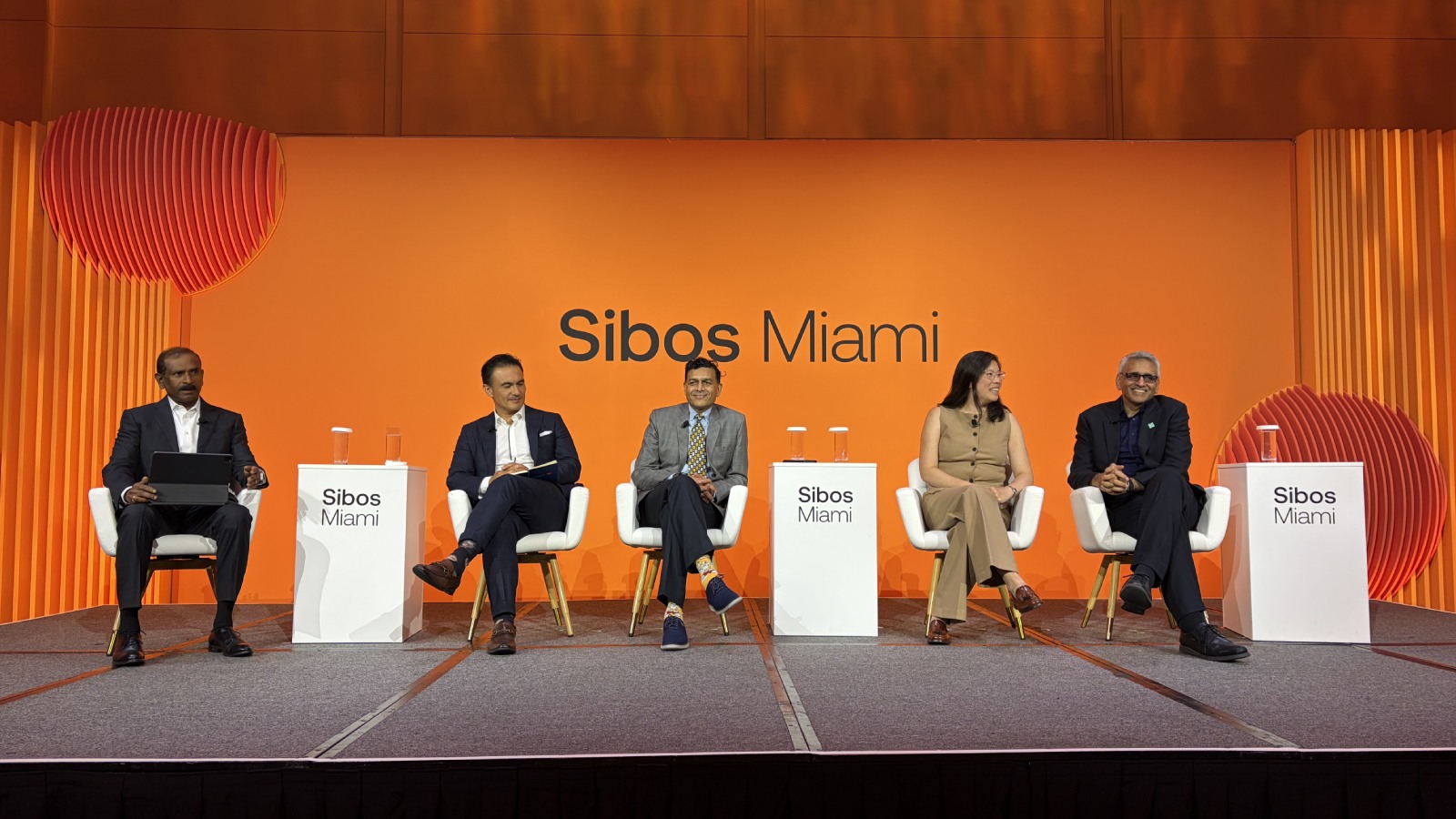



INTERVIEW | At PostTrade 360’s conference from 1-3 September, International Securities Services Association CEO Julia McKenny shared how it’s acting on a key insight from the May symposium that firms’ need “resilience by design” rather than tactical fixes.
ISSA’s May symposium, which gathered members and provides senior personnel at the association to discuss and debate key themes, argued geopolitics is moving from episodic to structural. How is the shift from tactical fixes to resilience by design revealed at the symposium informing ISSA’s agenda currently?
JM: This year, the ISSA conference theme was ‘Global Turbulence, the Digital Tsunami and our Client’. This recognises the ongoing risks and challenges of geopolitics and geoeconomics and the profound impact these have on the Securities Services industry and beyond.
During the Symposium there was a great debate around the theme of Resilience, Recovery and Resolution. The concluding thoughts pivoted around diversifying suppliers and geographies, building resilience into new systems from the outset rather than bolting it on after an incident, mapping international sanctions/regulatory conflicts, and planning for employee safety during geopolitical crises. It also flagged that firms currently don’t understand where their own interconnected dependencies lie or who owns recovery once a crisis starts – so a first practical priority is closing that visibility gap. The session pushed this beyond individual firms too, proposing industry-level trusted communication channels, shared escalation mechanisms, common exposure metrics, and a shared “global resilience playbook” tested through industry-wide wargames. This has been picked by ISSA as an item to take forward.

ISSA distributed a client survey to its membership to gain the client perspective and ensure that there was clarity and alignment regarding client expectations. The biggest gap between client expectations and current industry capabilities was around the speed of change and innovation. How can ISSA help drive the client change agenda?
JM: The client survey found the two sharpest gaps are data standardisation/interoperability and speed of change, against rising demand for modular, API-driven, digitally connected services. The Symposium discussions concluded the gap is most acute in institutional client onboarding – unstandardised, manual, duplicative, and slowed by the fact that KYC data collection can be delegated but liability for misidentification cannot. For the next 12 months, the group explicitly rejected a “Big Bang” fix in favour of ten incremental measures that deliver early wins and quick cost savings – a shared client-data repository was floated as the biggest win but also the most contentious, likely needing regulatory push to overcome firms’ reluctance to pool data.
ISSA and its membership are currently focusing on multiple areas where the client agenda is front and centre. This includes institutional client onboarding where the focus will be on ten incremental measures that deliver early wins and quick cost savings. ISSA is also coordinating and collaborating with multiple other industry groups with the aim of facilitating a broader industry solution.
Additionally, ISSA has created an Investor Solutions Working Group which is currently focused on end-investor distribution channels. The group is seeking to better understand the barriers to improvements and innovation and provide educational and informational tools to assist the design of solutions that meet the investors’ needs.
The Symposium report flags that most firms deploying agentic AI still haven’t resolved who’s accountable for mishaps such as NAV errors and missed corporate actions deadlines. How is ISSA thinking about governance and accountability as AI moves from a tool to core infrastructure?
JM: Agentic AI accountability ISSA’s research frames 2026–2028 as the point AI stops being a peripheral efficiency tool and becomes core operational infrastructure. Discussions at the Symposium agreed that accountability is a key open problem. 82% of firms using agentic AI report data-related risks and 51% report hallucinations, with real exposure to NAV errors, regulatory misreporting, and clients missing corporate actions deadlines. Their answer wasn’t a single accountability model but a governance requirement – clear decision-making paths with defined ownership and escalation, human “course-correction” retained even in high-volume processes, and firms that pair AI with strong governance/data controls expected to outperform those treating it as bolt-on. The group also warned that if the industry doesn’t self-organize common standards, regulators could impose them. ISSA is therefore proposing to create a set of shared principles to avoid market fragmentation.
On cyber as a financial, not technical, issue: the symposium considered moving cyber from the CISO to the CFO. The reason given was that cybersecurity issues are fundamentally an efficiency and cost problem. How was this debated and how is it likely to change how firms resource cyber defence?
JM: It was stated that successful attacks are usually an organisational failure (unused patches, poor internal process) rather than a technology gap. There was consensus that shifting ownership from CISO to CFO facilitates a more holistic, efficiency-driven lens. Whether this reshapes resourcing is genuinely open. Cyber spend is already rising 5–10% a year so firms really do need to concentrate on the ability to both prevent and manage cyber-security as effectively as possible.
On digital assets and tokenisation: The DTCC’s move to tokenise Russell 1000 equities and Treasuries is being described as the credible route to scale for digital assets, more than crypto-native tokens. Does that match what ISSA has heard from members about client demand? What’s the tipping point for scaling digital assets?
JM: Yes, this matches member sentiment closely. ISSA’s recent survey, in collaboration with The Value Exchange, found that tokenisation of securities, particularly for collateral use, offers multiple industry benefits and could well act as a tipping point. ISSA’s Digital Assets Working Group is currently finalising a paper on tokenised collateral use cases as well as looking at other key requirements to support digital assets being adopted more broadly – such as Wholesale Digital Money and tokenised money-market funds.