








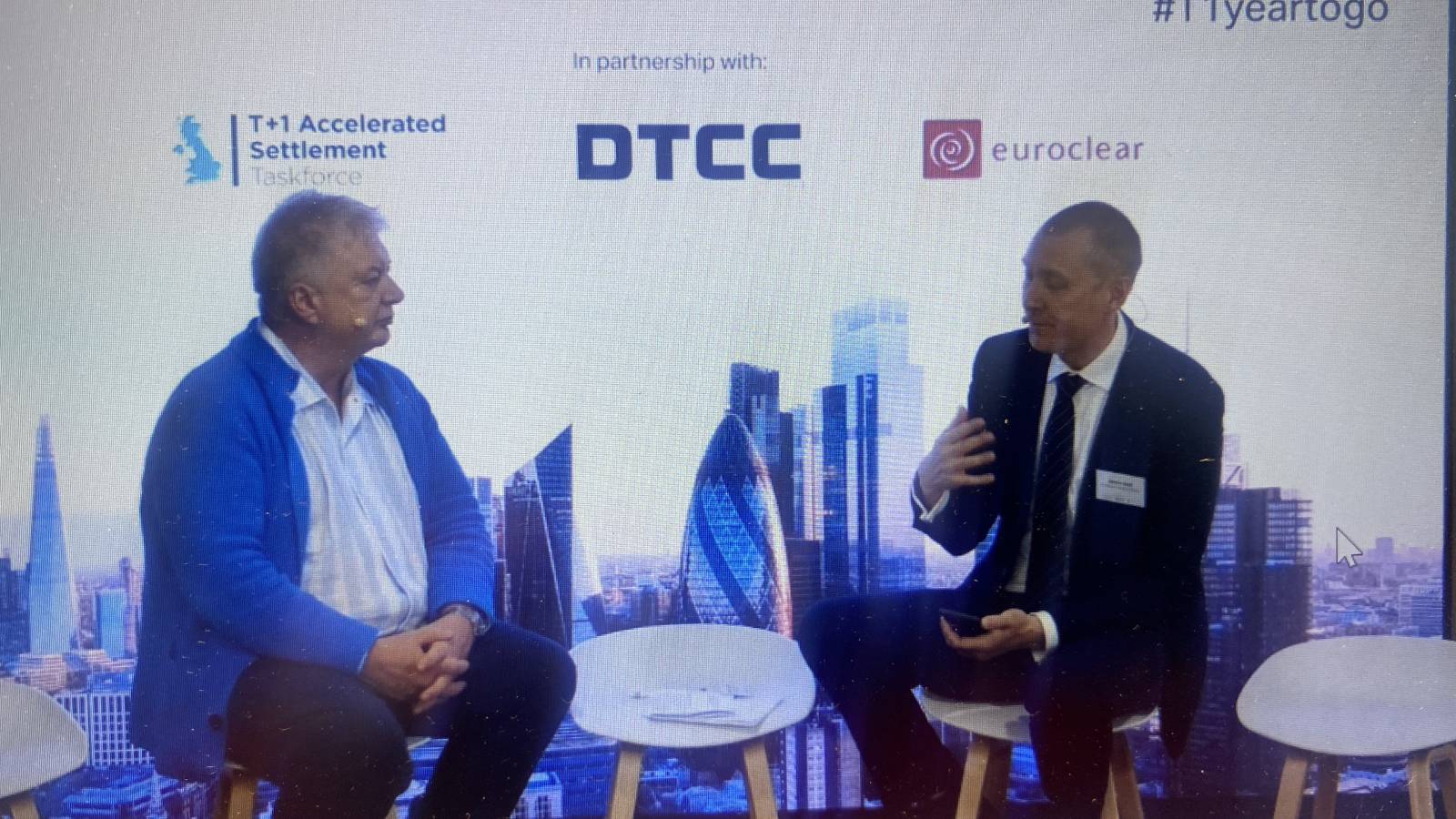


In the future, AI agents will be manning supermarket checkouts. Instead of paying for our groceries with cash or a credit card, we will make the payment with one of our many tokenised assets, chosen by the AI agent based on how well its value matches the price of the purchase. This is the vision Michael Duttlinger, CEO and co-founder of Cashlink shared with the audience at Sibos 2025, in the session titled “Capital markets 2.0: how token-based securities, stablecoins, and digital money reshape FMI”.
It isn’t just supermarket checkouts that will be transformed, of course. “We’ll see more distribution channels, because it’s going to be easier to distribute securities,” He predicts. Crypto brokers that have been distributing cryptocurrencies will want to move into distributing securities as well – not by integrating traditional capital markets infrastructure, but by having securities on the same infrastructure as cryptocurrencies.
Rule follower
What Duttlinger has described is a vision for the longer term – attainable only if some changes occur in the short term, namely regulation and cost cutting. “Germany has the most advanced blockchain laws worldwide,” he claims. “The US is looking into German laws and EU laws and is now enjoying second mover advantage as it introduces its own tokenisation laws.”

The EU currently still has time advantage, but it would not be for long. By jumping on the tokenisation bandwagon, the US is putting pressure on the EU to continue innovating to stay competitive. Whatever moves the US makes is also likely to influence accelerated market adoption worldwide. Duttlinger believes that tokenisation is heading towards exponential growth, but only if regulation keeps up.
“I cannot stress enough that regulation at this point is a key factor, a necessity, and very important for financial institutions,” he says.
Under the wrapper
He recalled the early days of tokenisation, when most financial institutions “didn’t really want to touch tokenisation”. It prompted smaller firms to build wrappers around existing products – locking an asset on one blockchain and creating a representative token of the same asset on another – to circumvent the fact that blockchains are siloed ecosystems that cannot interact with one another.
The issue with wrapping is that “you cannot look into a security and know what’s there because it got wrapped and wrapped and wrapped”. On the other hand, if it’s all on chain, “you can see, transparently, how all the securities are interconnected”. This makes regulation easier, and Duttlinger believes was one of the factors that prompted regulators to eventually look into tokenisation.
Big leagues
He is observing a shift now as bigger financial institutions are beginning to issue products that are native on chain. “We will see more volume coming into the space. We will see a completely different risk rating with financial institutions doing the issuance compared to smaller companies doing wrappers.”
In Duttlinger’s estimation, four levels of regulation are required before his vision of capital markets 2.0 can become reality – in the registered tokenisation layer, secondary markets, stablecoins, and custody. “If we have all four components regulated and on the same public blockchain, that is the point where we can really create an ecosystem for capital markets 2.0 – fully regulated, risk assessed, and controlled by the public. That’s when we will see adoption.”
Sibos 2025 plays out in Frankfurt from 29 September to 2 October, with about 12,000 registered delegates. We are there, overview our coverage here.