
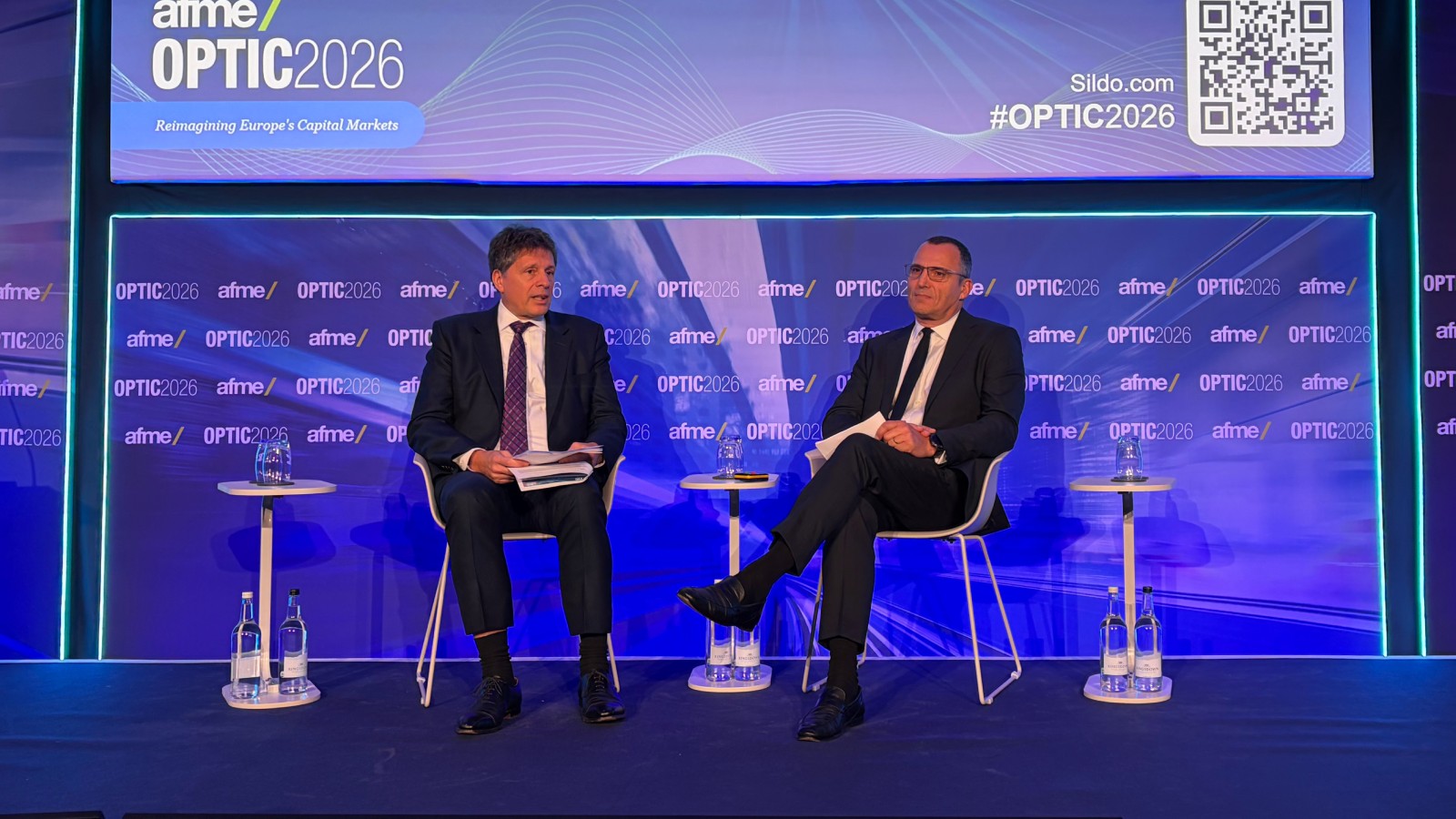








The numbers don’t lie: Europe is currently sitting on approximately €10 trillion in household savings that, if properly invested, could boost GDP growth for the region by 1.5% over a 10-year period, and address a €750-€800 billion investment gap. Describing the region’s current situation as having reached a “pivotal transformational moment”, Adam Farkas, CEO of AFME, sat down with Chris Cox, head of Investor Services at Citi, in a fireside chat at the Optic 2026 conference to discuss the challenges – and importance – of mobilising the bloc’s fragmented markets.
“The EU capital markets are characterised by more CSDs than nation states,” says Cox. Although many of these organisations have started converging into groups in recent years, “the convergence has not translated quite as much as it could into harmonisation of operational processes, singularity of accounts, and unified account structures.”
He reiterated an analogy first used by Jane Fraser, chair and CEO of Citi, in her speech at the opening plenary at Sibos 2026. “It’s possible to travel across Europe via railway, but there are certain borders where the gauge of the railway changes. At those borders, you need to stop, slow down, and pay the cost of moving the freight from one gauge to another gauge. I think that’s a good analogy for the situation we are finding ourselves in, in the EU.”

Fragmentation has led to an issue unique to the EU – innovation penalty. Cox pointed out that innovation capital that has to be distributed across “30 different venues” runs the risk of not aggregating or coalescing. Unlike the EU, “that’s not what we are seeing in the US”. Case in point: the DTC has launched tokenised equities and digital twins and “there is more to come,” he predicts.
Start small
Although Cox claimed that it is not in his place to advocate consolidation, there are other “practical, simple steps” that can be taken. “Mandate open access. Mandate interoperability. Mandate common data standards and common data ontology. There are good examples of it in other industries – open banking and open communications, where these simple changes have brought real value to clients.”
He cited the results from a survey Citi carried out. “The feedback was that legal and regulatory divergence is a primary obstacle to post-trade integration. In many ways, it’s worsened by the use of directives that facilitate national – let’s call it gold plating.” He suggested that the sector would welcome more direct supervisory oversight from the European Securities and Markets Authority (ESMA), “somewhat mirroring what the European Central Bank (ECB) does in banking, eliminating national carve-outs and providing more regulatory consistency”.
Such consistency can come from “simple but profound foundational primitives”, such as common issuance frameworks, single points of issuance, and single EU-wide ISINs, which would all give “immediate benefit in creating more borderless EU capital markets, driving liquidity, and making securities move around irrespective of choice of venue”.
Watch across the Atlantic
A running theme across the whole discussion was how EU markets have fallen behind the US. Cox had began his presentation with a list of leading European companies that have chosen to list in the US, proving that there is clear motivation for the EU to make its capital markets “a more attractive destination for capital formation”. He pointed out that the EU fund market is currently about a fifth the size of the US one. But instead of seeing this only as a negative, he saw it as an opportunity for growth.
“For the European markets, I would be concerned that the US is possibly about to take another leap forward in the speed at which it modernises. Therefore, I do think it’s an important moment in terms of where European capital markets are and the decisions that get taken.”