
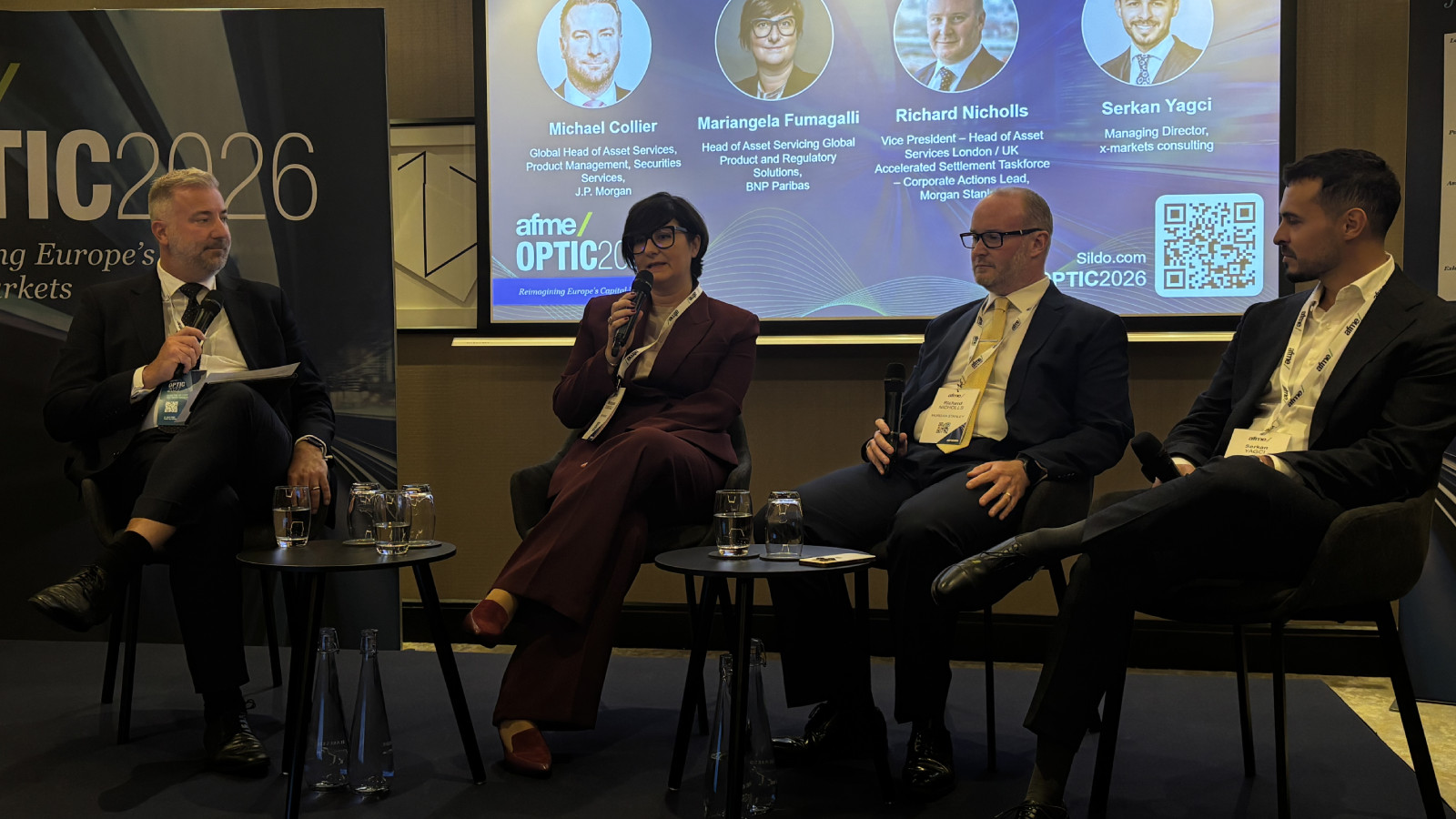









The shift to T+1 settlement is forcing the securities services industry to reconsider how corporate actions are processed, particularly as shorter timelines leave less time for voluntary events. At Optic 2026, panellists in the session Asset Servicing in Focus: Challenges and Opportunities discussed how regulatory differences, manual processes and competing interests across the market continue to hinder harmonisation.
Richard Nicholls, vice president and head of Asset Services London at Morgan Stanley, said the time available to process voluntary corporate actions would shrink significantly under T+1. “Losing that day will take 15 hours down to 5 hours,” he said.
In the UK, efforts are under way to move investor protection forward by 24 hours and extend deadlines for elective events. But changes affect multiple parties, including receiving agents, which may have less time to complete their own tasks.

Standards and regulation
For Mariangela Fumagalli, head of Asset Servicing Global Product and Regulatory Solutions at BNP Paribas, the industry has already made progress through standardised messaging and automation. The next step is to embed agreed standards in regulation and address differences between national implementations of shareholder rights rules. “We need to try to get rid of all the differences that we have,” she said.
Serkan Yagci, managing director at x-markets consulting, argued that regulation remains one of the main drivers of industry investment. He said T+1 could help firms secure resources for projects that also support broader harmonisation, even if it does not directly accelerate the process.
AI as an interim measure
Technology could help ease some of the operational pressure while harmonisation progresses. Yagci said AI could reduce manual work involved in gathering and reconciling event information from multiple sources, but stressed that it would not resolve the underlying data issues. “It will not give us a golden copy or a golden operational source which everyone can use,” he said.
Nicholls also pointed to longer-term possibilities involving distributed ledger technology and faster settlement, while warning that corporate actions remain complex and depend on resolving inefficiencies elsewhere in the processing chain.