



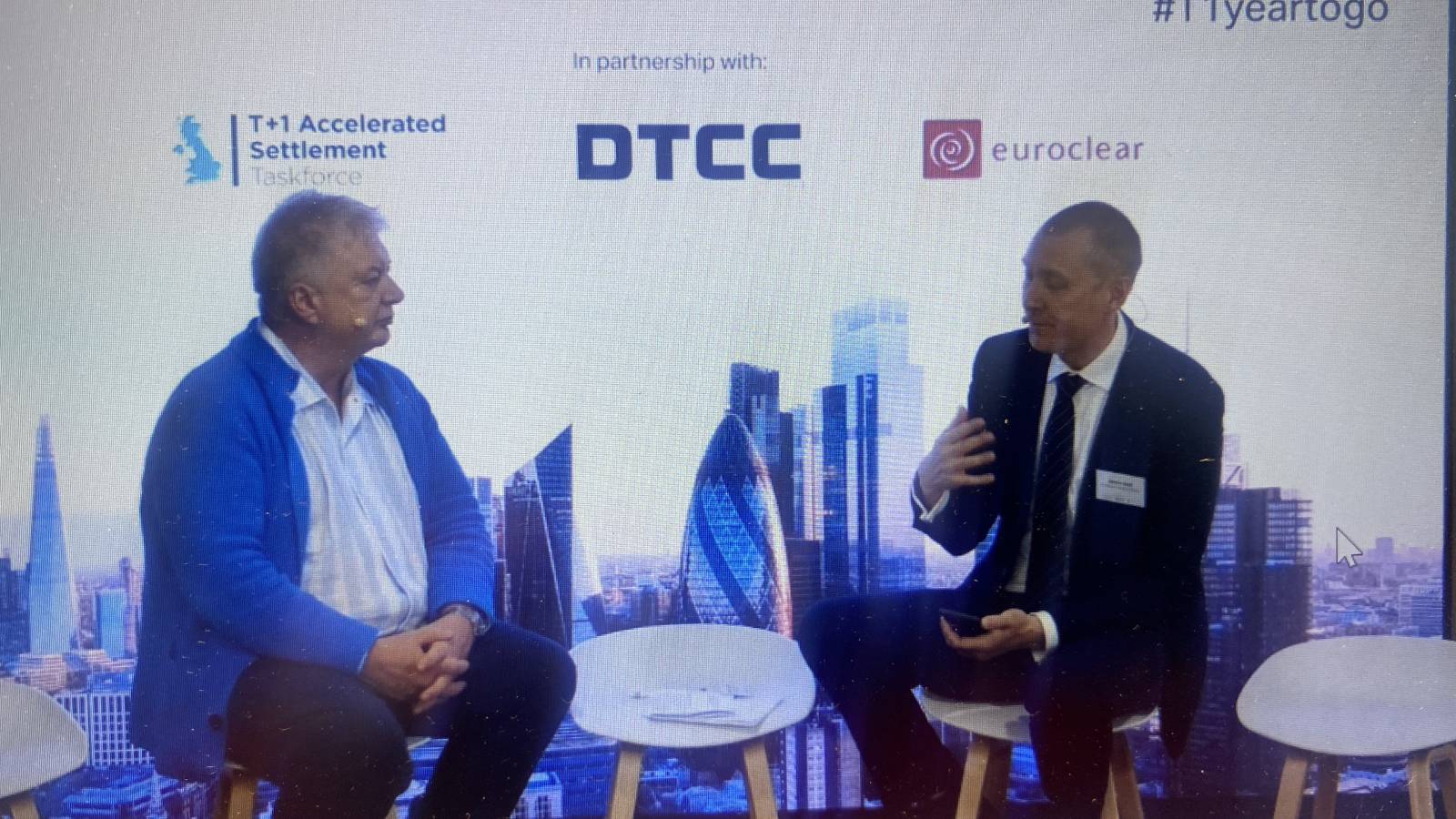







INTERVIEW | October 11, 2027 will mark the implementation of T+1 in the UK, EU, and Switzerland. As the one-year countdown to the date draws nearer, the industry is ramping up preparations. We caught up with Ola Mjorud and Marcello Topa of Citi to find out what might be in store for market participants in the run-up to a shorter settlement cycle.
2026 will likely see many recommendations that so far have only been on paper realised in practice. In the words of Mjorud, Citi’s Nordic head of Custody, a “crystallisation of requirements” has been happening since the start of this year. In the EU, preparation groundwork is guided by the High-Level Roadmap published by the EU T+1 Industry Committee. The UK has its equivalent in the Implementation Plan drawn out by the Accelerated Settlement Taskforce (AST).
To take real-world application a step further, the EU, UK, and Switzerland will be embarking on synchronised testing as outlined by the T+1 Testing Plan. Jointly released by the EU T+1 Industry Committee and AST in March this year, the plan sets out a framework for testing logistics, touchpoints, and scenarios.

Closer to home, 2026 will also mark the beginning of Sweden’s preparations for the transition. On 12 October this year, the country will be shifting to a longer settlement day, with the last settlement batch at 4pm. Mjorud expresses optimism about the shift: “The last time we extended the hours of the operating day, we saw an improvement in settlement rates in Sweden.”
An issue of scale
The challenge of T+1 is not merely technical – because the industry is already capable of handling a shorter settlement cycle. Topa, Citi’s global head of Advocacy for Investor Services, points out that although the industry is currently settling at T+2, it is already possible to handle T+1 and even same-day settlement.
“The challenge,” he says, “Is when we start doing these things massively at scale, with transactions not only in the hundreds per day, but in the hundreds of thousands across the entire industry. The challenge is to ensure that we have streamlined processes from trade and trade execution all the way through to settlement and post-settlement so that we can accommodate the removal of one operational day.”
Cutting one operational day is equivalent to reducing 80% of the processing time between trade execution and settlement. This leaves very little room for errors.
“It is not just a settlement change. It’s an industry change, and an ecosystem change,” Topa emphasizes. “It’s not a single recipe, or a situation where one single change can serve as a magic wand that resolves everything. Every single piece counts, from legislation to operational processes to settlement finality rules. By looking at all these individual pieces, the total sum is going to be a shorter settlement cycle.”
Too many cooks
Following the successful transition to T+1 in the US in 2024, Europe has second-mover advantage. “What we learnt from the US is that the transition touches more than just post trade. It’s also about market practice,” says Mjorud. “We have to look at what this means, from the decision to do the trade, to executing it, then clearing and settling it, and what happens after.”
But this is where Europe will stop finding references from the US useful. Replicating a market practice in individual markets adds complexity – and cost. “It is likely that the T+1 transition in Europe will be vastly more expensive than it was in the US due to the number of banks, infrastructures, and currencies that it touches,” Mjorud predicts. “There are more actors in Europe that have to adapt, so collaboration really is key. It is going to take the whole village to do this.”
Even within a smaller, closely connected region of Europe – the Nordics – differences are significant. Between the Danish, Finnish, Swedish, and Norwegian markets, there are four different currencies, different levels of commitment to the TARGET2-Securities (T2S) plaform, and different requirements for omnibus and segregated accounts.
“The differences are fundamental, and in everything,” Mjorud points out. “My opinion is that Europe is currently not doing enough to get those synergies right. For example, we do not have a consistent schedule of ex-dividend dates, record dates, and pay dates that work exactly the same in all the different markets.”
“It’s a lost opportunity,” he continues, “But the settlement day, we can at least agree on.”
Topa agrees. “One of the key challenges in Europe is that we still have inconsistencies between national jurisdictions and national legislations vis-à-vis the the European requirement… Despite the many decades of European legislation, there have been too many directives that then need to be translated into, and transposed within, national jurisdictions – and now, we need to translate those into a single European legislative environment.”
“T+1 is a great catalyst for this type of operational changes. We need to start thinking with the same logical framework – how each step in the process can be interpreted and accommodated despite the specific challenges that each market might face.”
Let’s talk
Topa believes that communication is going to be key to success, especially from financial market infrastructures (FMIs) at the top of the process flow. “They create a dependency for everyone else, so they need to be the first to state what they will do in terms of preparation – and most importantly, what they will not do.”
“The roadmap published by the EU T+1 Industry Committee says that FMIs should accommodate for discussions with their users and clients on the alternatives that are going to be put in place if a process is not going to be implemented,” he reminds. “You cannot simply say, ‘We are not doing this,’ and pass the problem on to your clients.”
Honesty is the best policy
Fundamentally, the preparation for T+1 should be viewed as a self reflection exercise. “Market participants need to be realistic in their own internal assessments,” says Topa. “You have to be honest with yourself about what you are capable of doing versus what you might potentially need help with. Be realistic about the plans and putting in the appropriate level of resources where required. Do your homework, and do it honestly by factoring in your own opportunities and challenges.”
Mjorud adds, “The important questions are almost like soul searching – am I ready for this? Have I done everything I can?”
Although the current focus is on getting market participants through implementation day successfully, Topa stresses that that is not the be-all and end-all. “Let’s not forget that the work will continue after 11 October 2027. T+1 is not the end result, or the end goal. We will probably start thinking about T0, so T+1 is just a step in the process of a more integrated and efficient system. All the changes we are implementing now should have a future validity – not just something that works for now.”