












The world continues to move faster. The pace of change and innovation is accelerating organisational and infrastructure changes across the financial system. In 2026, we will see developments across five focus areas: greater speed in securities settlement and real-time payments, central clearing in US Treasury markets, greater collateral mobility, increasing adoption of digital assets and blockchain technology, and AI’s ability to transform productivity and growth. Preparations to provide continuity, resiliency, and optionality will be critical to maintain client trust and safety in this rapidly changing environment.
Speeding up securities settlement and real-time payments
Asset and payment flows are accelerating as global capital markets are modernising. Institutions now demand fully integrated, end-to-end platforms and institutional clients want speed, certainty, and real-time visibility on transactions.
Securities settlement

After the transition to T+1 settlement in the US, the rest of the world is working to make faster settlement a reality. In the article From SIU to T+1: transforming post-trade settlement in Europe, we noted how the EU, UK, and Switzerland are expected to implement T+1 by October 2027, with the EU aiming for full systems implementation by the end of this year and testing beginning early 2027. In Asia, market participants are actively reviewing the feasibility of implementing T+1 for different types of securities before setting firm transition timelines.
The year ahead will be an important one for this transition. Across the EU, UK, and Switzerland, the focus will be on implementation and client readiness. Misalignment could ripple through the chain, therefore successful migration will depend on:
• International cooperation between public and private sectors
• Robust preparation to ensure operational readiness
• Testing to mitigate risks of trading parties following different trade lifecycles across jurisdictions
Real-time payments
Global real-time payments will continue to scale rapidly across markets, expanding use cases, increasing volumes and interoperability. In 2026, we expect expanded payment rail connectivity and further technological innovation to drive faster, more transparent cross-border payments. Key opportunities for 2026 include:
• Enhancing interoperability via SWIFT pilots (retail scheme and ledger) to simplify cross-border payments
• Investing in both payment validation and fraud-prevention technology
Central clearing in US Treasury markets
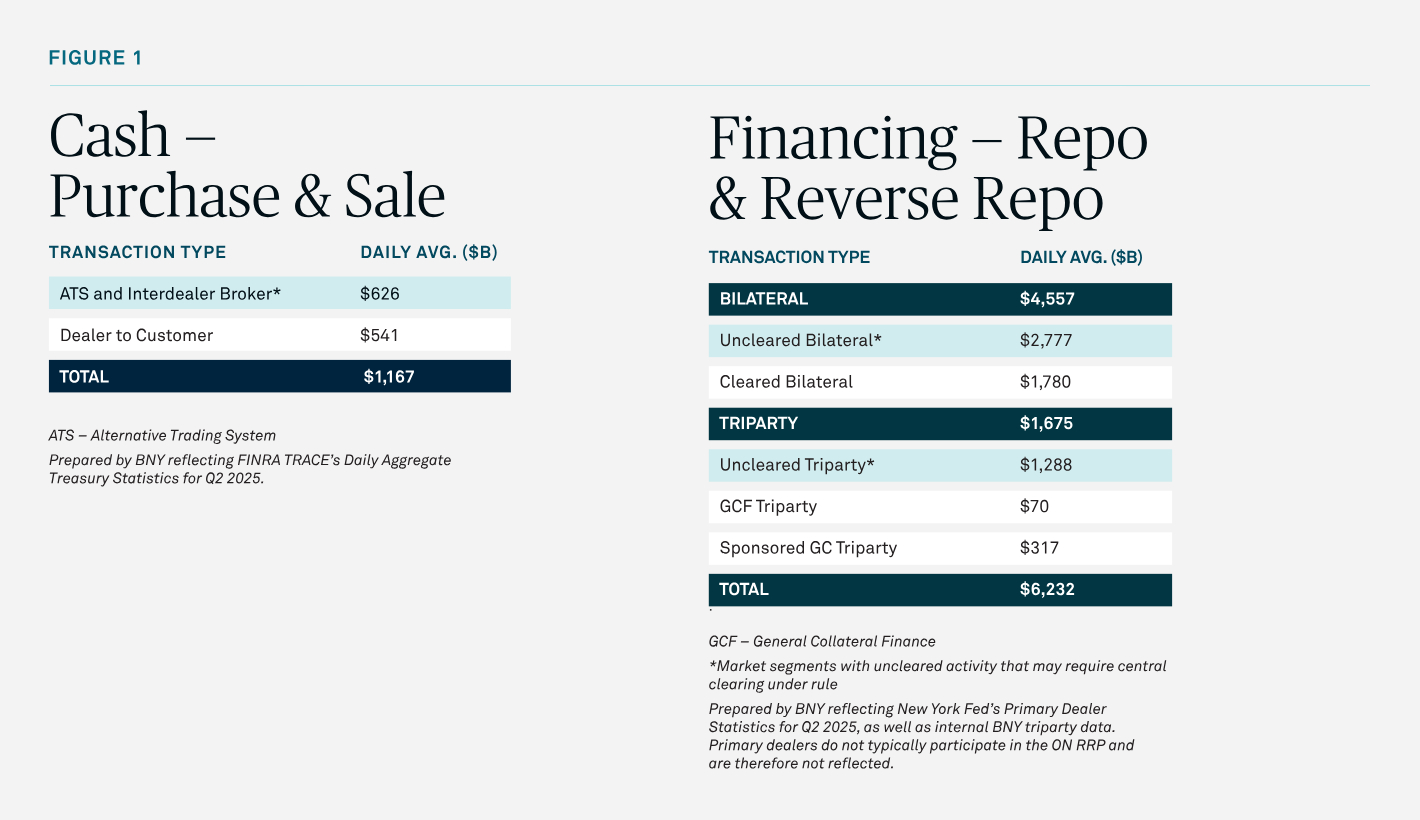
By the end of the year, eligible cash transactions in the US Treasury market will transition to central clearing, with eligible repo and reverse repo transactions transitioning by June 2027. With an estimated US$4+ trillion in daily uncleared transactions in scope, (figure 1) this shift is significant, and we have continued to provide our perspectives to clients through its evolution. US firms recently reported that they have a high degree of confidence in readiness for the transition while Europe and Asia need to work quickly to catch up. This year will be important for all firms to make meaningful progress and prepare for the transition, including:
• Assessing which types of transactions will require central clearing
• Determining an access model and provider
• Adjusting risk management practices to address the implications of central clearing for margining and collateral management processes
• Conducting ongoing change management, prioritising documentation around access models as well as system and process changes
Greater collateral mobility
Institutions looking at new investment opportunities will pursue additional ways to put their assets to work, increasing the strategic importance of collateral mobility and intraday liquidity. Central banks and private sector platform providers will build off their work in 2025 to harmonise collateral systems and optimise collateral use. In Europe, following the launch of the Eurosystem Collateral Management System, market participants across public and private sectors will look to further refine their operations. In the US, following the expansion of the Federal Reserve’s Standing Repo Operations (SRP), there will likely be a push to create more interoperability between collateral platforms, including the Fed’s Discount Window and SRP, the Federal Home Loan Bank system and private sector third-party platforms. As with other market developments, institutions will need to prepare by:
• Being operationally and legally (i.e., documentation/agreements) ready to mobilise collateral
• Prepositioning assets to plan for contingencies and allow for swift draws
• Strengthening intraday liquidity management by forecasting payment flows, market margin calls, and settlement timelines
Increasing adoption of digital asset and blockchain technology
In the article, The digital revolution: transforming financial market infrastructure, we highlighted how the rise of blockchain technology is enabling a new operating model in which traditional financial infrastructure is evolving (as noted above), while also embracing digital rails – fundamentally transforming how assets are recorded, transferred, and moved. Three key areas stand out as ones to watch in 2026 as adoption of digital assets and blockchain technology progresses:
• Digital cash and cash equivalents: Stablecoins and tokenised deposits are poised to see greater adoption this year as use cases develop further.
• Tokenisation: Market participants will lean into exploring tokenised real-world assets and liabilities to help drive greater efficiency and liquidity in markets and on balance sheets.
• Regulation: Policymakers will continue to pursue domestic legislative and regulatory frameworks while jurisdictions also work towards harmonising regulations globally.
These developments will progress throughout this year and over the longer term, but the key to unlocking these opportunities will be the interconnectivity between traditional and digital systems.
AI as an enabler
With greater speed and 24/7/365 operating models for institutions and markets, humans can benefit from AI-driven tools to help proactively identify risks, prevent fraud, and strengthen market resilience. At BNY, we are using AI-based solutions to further improve quality and agility. For example:
• Settlement prediction: BNY’s Predictive Trade Analytics uses AI and patented technology to analyse trade patterns, identify high-risk transactions and help anticipate potential settlement failures before they occur, enabling proactive intervention and reducing operational risk.
• Payment validation: BNY created AI-enabled digital employees to help validate payments that cannot be straight-through-processed, improving speed, accuracy and transparency.
In the article, AI in the next phase: driving adoption, we detail our AI journey and offer several learnings that can help firms navigate further adoption in 2026:
• Adoption approach: Out of a range of technology options available, consider what approach delivers the most strategic value and differentiation while providing flexibility and efficiency for the long-term.
• Empowering employees: Technology alone does not drive transformation – people do. Build a culture of learning where employees can use a variety of pathways to upskill themselves.
• Governance to scale: Having the right governance frameworks not only helps deploy AI in a responsible, risk-managed way, it is essential for building scalable solutions.
Final thoughts
As these developments drive modernisation in global markets, preparation will be essential to unlocking the benefits. BNY stands ready to help our clients navigate these changes, enabling a trusted ecosystem that supports growth and investment.