









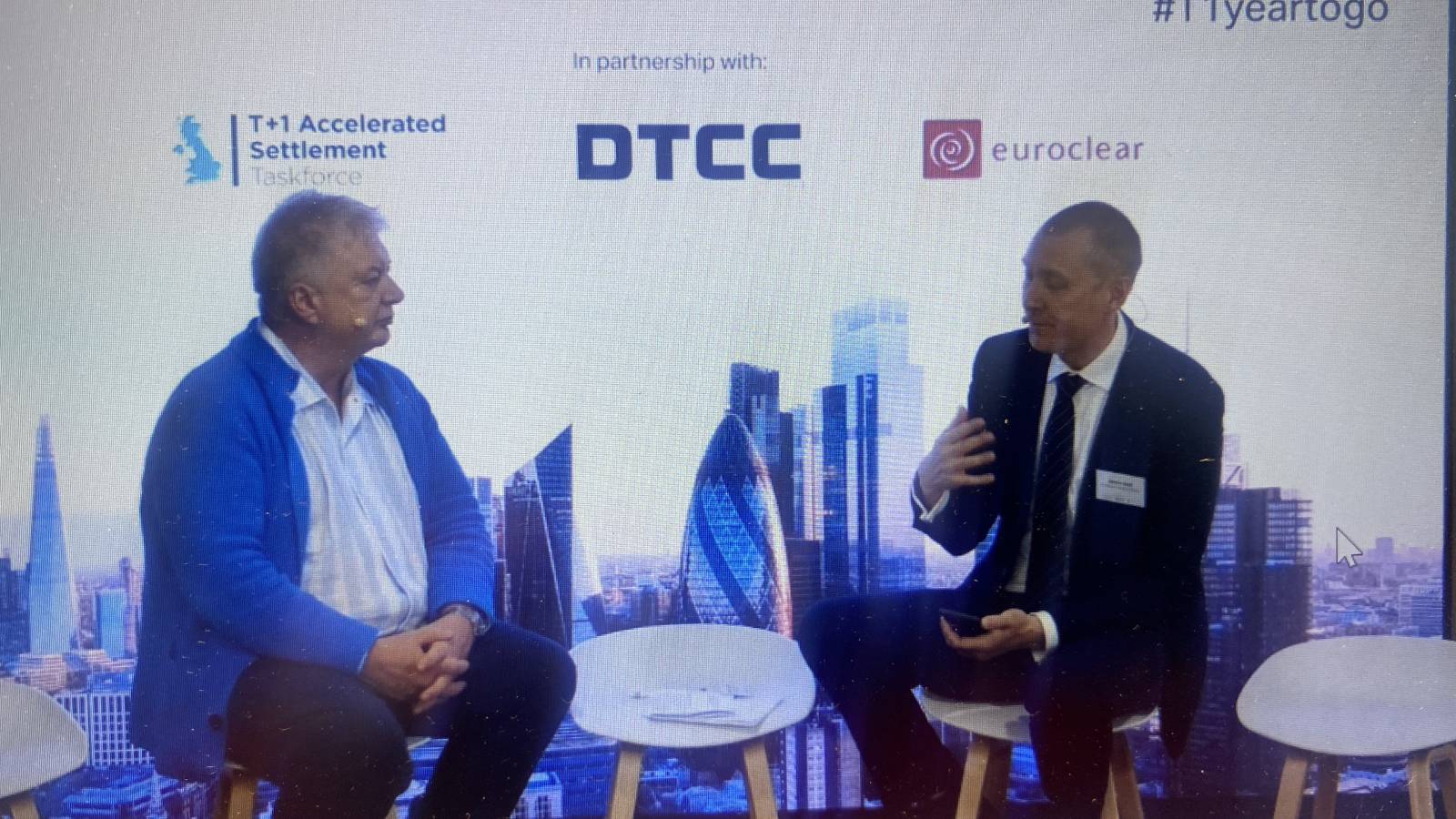


As the EU continues its effort to harmonise the bloc’s financial markets, the tension between integration and longstanding local practices remains a challenge. At the ECSDA Post-trade Conference 2025, six experts explored solutions to improve liquidity, cross-border investments, and financing opportunities in the panel titled “Navigating European Integration – Enhancing Liquidity and Financial Growth”
Sam Riley, CEO of Clearstream Securities Services, pointed out that harmonisation can only happen when everyone is playing the same game. “We (Clearstream) are the only CSD that is connected to all the other CSDs,” he says. Although the firm is proud of what it has achieved and its clients are benefitting from the connectivity, having only one well connected CSD is not going to advance the region’s bigger financial market transformation. “Today, realignment is still necessary to go to another CSD for certain product types. There is not interconnectivity on both sides of the fence,” he explains.
He believes that connectivity is also what will give clients choice. “What the clients are looking for is optionality, which is the ability to choose where they set up their securities, and to do that in a way that they can choose. We, as human beings, don’t like to change, which means that if I am wanting to set up my French securities in France, and somebody else wants to set them up in Germany, I’ll still want to set them up in France.” Meeting these preferences requires standard settlement instructions (SSIs) and processes that apply across markets.

Embrace the diversity
David Murphy, visiting professor in practice at the London School of Economics and Political Science (LSE), argued that Europe’s regulatory and legal diversity is not something that can be swept away quickly – or perhaps at all. “Frankly, trying to fix that (fragmentation) in a hurry is going to be somewhere between very, very difficult and impossible,” he says. Instead, he proposed a more pragmatic approach – a “genuinely low-cost, low-risk infrastructure” to be built on top of local laws.
“I don’t believe in these grand projects to unify European corporate law or unify European notions of what it means to own an equity,” he confesses. “But I do think that moving from where we are to where we need to be does involve some creativity.”
Authority can wait
That creativity may well be a bottom-up, instead of top-down initiative – a pattern Riley has observed recently in markets with less stringent regulations within the digital space. Singapore, he mentioned, recently saw the launch of its first tokenised retail fund. According to Riley, in an environment with a lack of regulations, players have the space and motivation to prove to regulators that they can handle new processes, which leads to innovation. The same is potentially happening in Europe, with B2C providers “changing the way we do things”.
Initiative is coming not just from big firms, but also from individuals. Jakub Michalik, chief policy officer and member of the Executive Committee at Euronext cited a study done by the Organisation for Economic Cooperation and Development that showed that in France, 50 per cent of investments done by investors aged 18 to 30 are in Bitcoin.
“People in their twenties and thirties invest in a different way using different technology, tools, and intermediaries than the people in their sixties,” Michalik points out. “To be in a competitive environment, we need to ensure that regulation and supervision is harmonised and is foreseeable and also does not pick winners and losers based on form rather than the substance.”
Stay in lane
Close to the end of the discussion, Murphy commended the efforts the industry has made so far and the good intentions of the digital players, but reminded the audience to remain realistic. “We need to be honest about what we can achieve in the infrastructure space. We can make things more efficient and cheaper. We can make data shared and commonly available, and agree to all sorts of really good things, but we cannot encourage (for example) Belgian dentists to buy more equities. I think there are cultural issues too and those are not within the purview of the infrastructure industry to fix.”
The ECSDA Post-trade Conference 2025, held on 18 November 2025, is hosted by the European Central Securities Depositories Association (ECSDA). Follow our coverage in the coming days on the site.