



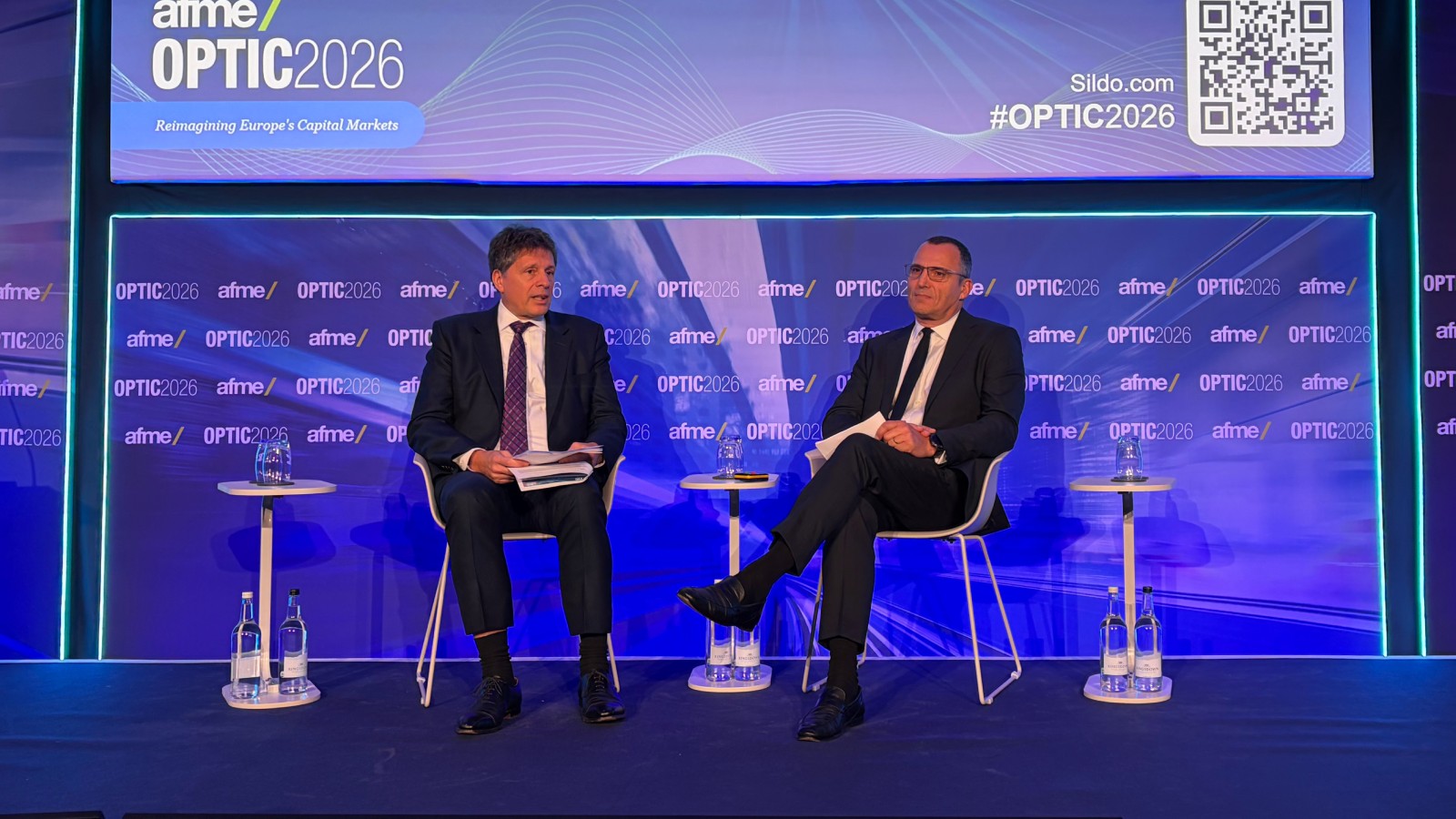








The industry has been excited about DLT for a while, so how close is it really to industry-wide adoption? In a panel titled “DLT adoption – are we approaching institutional mainstreaming?” at Optic 2026, five experts shared their views.
“We’re not quite there yet. We’re not seeing scale. We’re not seeing depth of liquidity,” says Sid Ulker, counsel in Financial Regulatory in law firm Ashurst Perkins Coie. Her opinion summed up the general consensus across the panel and across the discussion.
Varun Paul, senior director of Financial Markets at digital asset and stablecoin infrastructure provider Fireblocks offered a slightly perspective. “I think one of the things we’ve seen in the past 12 to 18 months is a big push coming out of the US. It started with the GENIUS act, which has pushed many banks to say, ‘We can engage with stablecoins and we can think about digital assets – we’re allowed to have these conversations now.’”

He believes that this, in combination with the launch of the Depository Trust and Clearing Corporation’s (DTCC) Tokenization Service, has encouraged many more companies to adopt DLT. “That’s how you build a whole ecosystem,” he points out, adding that the DTCC’s move has possibly induced more adoption across the pond in Europe and the UK as well.
A heavy burden
Still, despite the overall positive outlook, there is still hesitancy in the industry. The inertia, Ulker suggested, might be because DLT adoption isn’t truly about DLT itself, but about responsibility. “We’re talking about accountability, about service provision – and based on what we are seeing, we’re not really moving away from that. We’re still seeing traditional roles like registration and settlement systems… In fact, we have regulation that effectively requires it.” The DLT Pilot Regime in Europe and the Digital Sandbox in the UK were set up categorically to “unlock capabilities for a new type of settlement system infrastructure”.
To become truly native, the whole ecosystem and the entire infrastructure will have to go through an overhaul.
Angles of attack
Raising thresholdds in the DLT Pilot Regime and the UK’s Digital Sandbox could be a start, suggested Christoph Hock, head of Tokenisation and Digital Assets, DLT Transformation Lead, Union Investment. “They are by far too small to allow for scalability going forward,” he says.
Ulker agreed, and pointed out another weakness of the DLT Pilot Regime – it is meant to be temporary. In addition to raising the thresholds, “we would need something more permanent if we want to make use of the evolving technologies coming through,” she says.
Paul shared a second strategy – to build interoperable standards. Building systems that can only interact with an exisitng blockchain but have to “become something else to exist on another ledger” would simply be “recreating the problems of the past”, he warned. “Let’s make sure we build in a way that is interoperable. That does not mean it all has to exist on one ledger. it means that the systems we are building can interact across ledgers.”
“If the regulators are still nervous about public blockchains, that’s always going to be a problem,” he adds, saying that he hopes European and UK authorities will “finally get over the hump”.
Hock echoed Paul’s view that interoperability is not about every system using a single ledger, but about seamless interactions across multiple ones. “Do I want to have an infrastructure where cash and assets are on one ledger? The answer is no. Because that’s what we have in today’s financial markets with various centralistic structures and this – monopolies, oligopolies – come with high cost…”
“What needs to be preserved is investor protection, the financial market, and stability. Therefore, it’s a clear requirement when we act in markets that we do a very proper due diligence of all the counterparties involved in the entire chain.”