










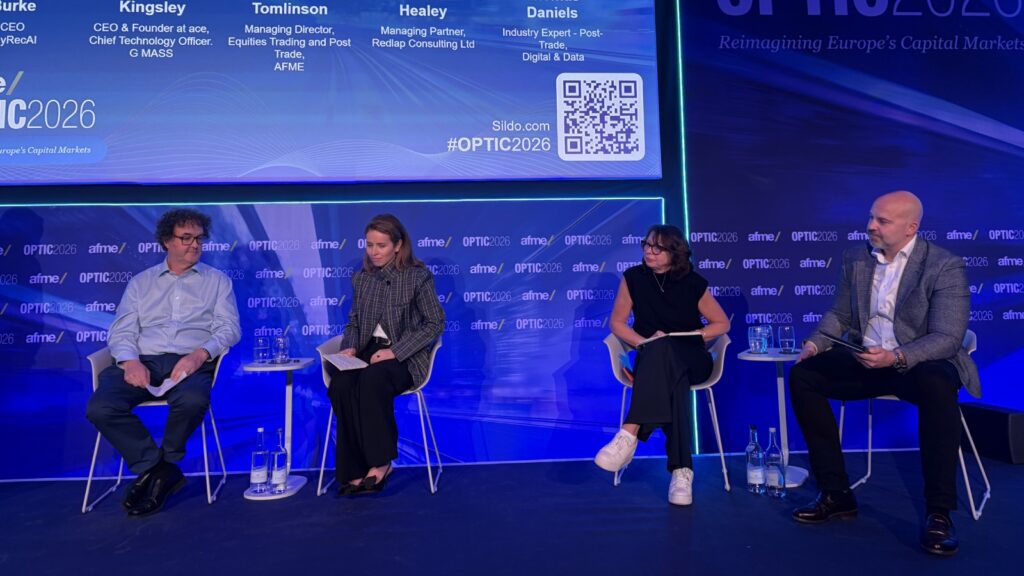
Post lunch on the second day of Optic 2026, five experts roused the crowd with a lively debate on the motion “This house would trust Claude to manage its settlement fails”. The verdict? Claude can probably be trusted – but it comes with caveats.
The proposition opened the debate by pointing out that the workflows for AI agents and operations employees already share a striking similarity. Operations analysts follow established rules and rely on senior managers to plan outcomes. When a settlement fails, anything outside of their limits is escalated. Rather than owning the risk, analysts only manage it. Similarly, AI agents are vetted by rules while humans retain final judgement.
Some hesitancy
The opposition followed with their counter-argument. They conceded that they might trust Claude to help manage settlement fails, but would not trust it to manage those fails autonomously.

“Capability does not equal authority. I don’t doubt that Claude could eventually outperform many human operators in identifying and resolving settlement fails. But does that automatically give it the authority to act? I would argue not.”
The opposition shared a second point: settlement fails are not always simply an administrative problem. Issues such as insufficient securities, counterparty disputes, liquidity shortages, and collateral shortfalls may require commercial judgement and an understanding of risk across the institution.
“The real constraint is governance, not technology. I’d happily trust Claude to identify settlement fails, investigate their causes, and recommend remedies. I’d even allow it to resolve straightforward exceptions autonomously, provided it’s operating within clearly defined controls. But when decisions involve committing capital, accepting financial risk, or prioritising one part over another, that is where I draw the line.”
The opposition’s final point was a more philosophical one – the need to preserve human capital. Today, junior operation professionals learn by investigating fails, understanding markets, and managing exceptions. If all of that is automated by AI, it would remove essential training that ensures the next generation of experts are capable of supervising the machine.
In rebuttal, the proposition reiterated the crux of their argument. Indeed, AI is not capable of anything that requires judgement, but an effective safeguard against that are limits and the rule that anything beyond those limits should be escalated. “We know that there needs to be rubber stamping, because humans rubber stamping the work is what already happens today.”
Put the brakes on
For the opposition, another issue is the speed at which AI is evolving – it might be moving too quickly for the industry to understand its full capabilities. “The speed of innovation is pulling us back to reconsider what we need to look at today in terms of control.” In the future, know-your-agent (KYA) might become just as much a standard practice as know-your-customer (KYC),
This concern with security is one that resonated with the audience, leading to a question about data resilience, the proposition stood its ground and pointed out that it is not an issue unique to using AI in settlement fails. Anyone working with cloud infrastructure or market intelligence would face the same challenge. These challenges, they countered, have more to do with data management, governance, and third-party regimes – which form a separate layer from AI challenges.
“I would ask the audience to rememeber that the question is whether we would trust Claude to manage settlement fails – not if we would trust it end-to-end, for the entire process. So would I trust Claude? Yes, I would.”