





69% of delegates polled during AFME OPTIC 2026’s panel on the evolution of market infrastructure want them to prioritise standardisation and interoperability, far ahead of new technology.
When the audience at an AFME’s OPTIC 2026 conference was asked what infrastructure firms should prioritise as they build towards their ideal future state, the answer was emphatic. 69% chose standardisation and interoperability. Reduced costs trailed on 12%, adoption of new technologies on 10% and maintaining resiliency on 8%, with collateral mobility on just 2%.
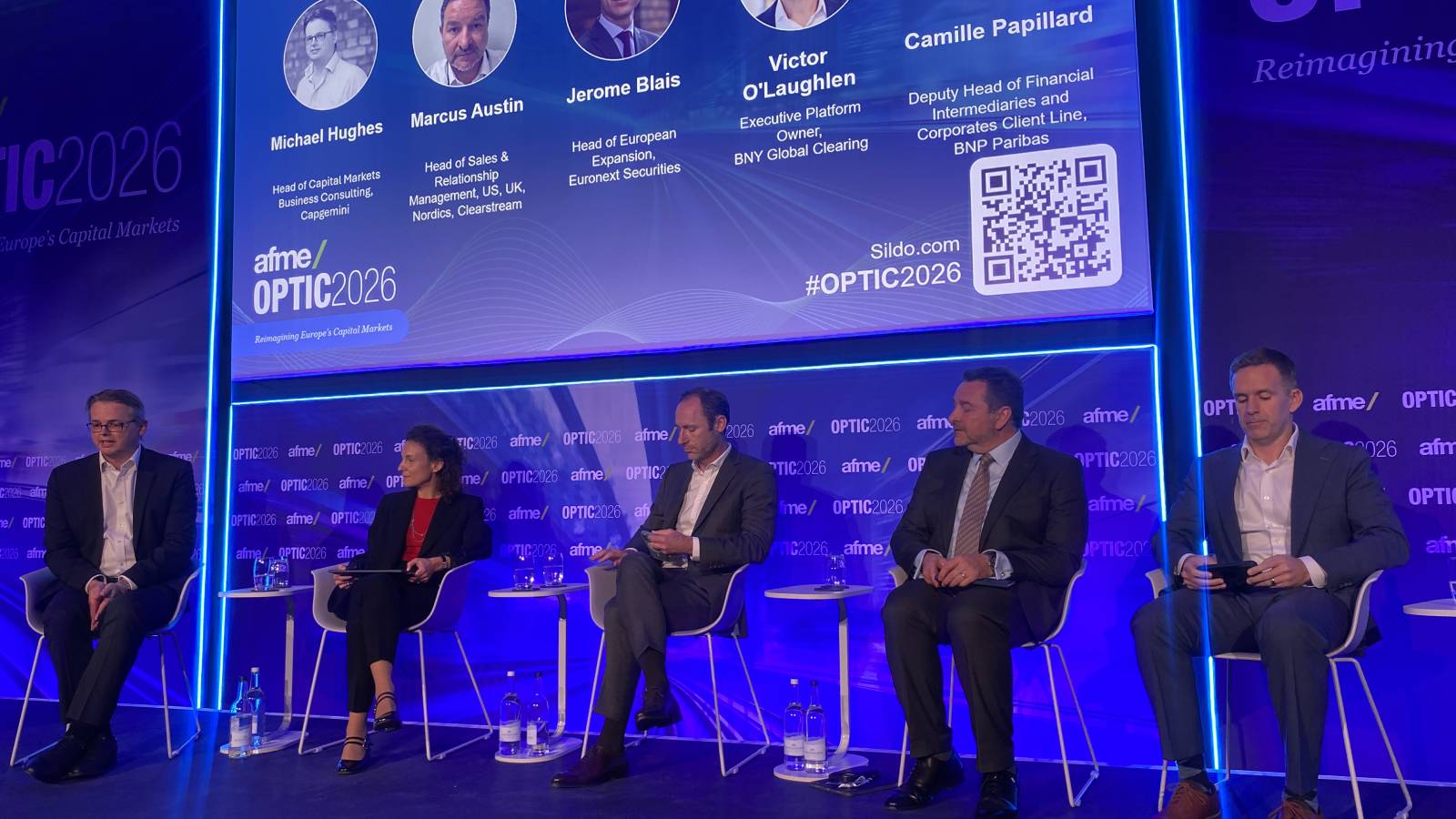
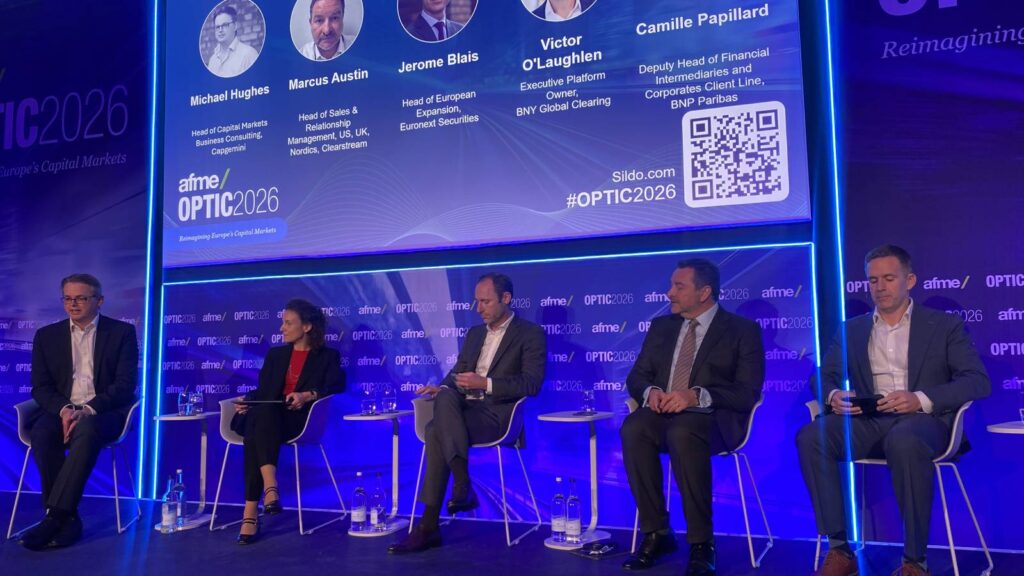
The vote, cast largely by the banks and intermediaries that use market infrastructure, came during a panel moderated by Michael Hughes, head of capital markets business consulting at Capgemini. Even he called the margin “a little unexpected”.

Fragmentation starts with the rulebook
An earlier word-cloud poll on the biggest challenge facing post-trade leaders was dominated by fragmentation, liquidity and interoperability.
For Victor O’Laughlen, executive platform owner at BNY Global Clearing, the cost of fragmentation is measured in liquidity. Every time a security moves between settlement locations it must be funded, he said, and cut-offs, fails charges and liquidity buffers “eat up the returns of the dealer, hedge fund, or whatever team it is”.
Camille Papillard, deputy head of financial intermediaries and corporates client line at BNP Paribas, argued the root cause sits upstream of the infrastructure. “Fragmentation comes first from a misalignment of the rules,” she said. Divergent readings of directives and national tax rules then produce “a spaghetti plate of different infrastructures”.
Marcus Austin, head of sales and relationship management for the US, UK and Nordics at Clearstream, warned against a “one-sided” fixation on FMIs. A pensioner in Sweden or Germany is not holding back from European equities because of the number of CSDs, he said. “It’s far broader than just looking at market infrastructure.”
Jerome Blais, head of European expansion at Euronext Securities, named inertia as Europe’s biggest strategic hurdle.
From working groups to implementation
For Papillard, the result means the industry must now deliver. Years of working group effort on corporate actions and proxy voting must move into an implementation phase, she said, noting that Europe still lacks a harmonised definition of a shareholder.
She called for fewer standards, consistently applied, and a “real single entry point to Europe, not just as a marketing offer”. Users want FMIs to be safe and efficient, she said, so “we don’t have different discussions with 32 or 34 different CSDs”.
Austin agreed the industry “can’t wait for regulation to be done to us”. He cited Euroclear, Clearstream and DTCC working on common taxonomies for digital assets because “we don’t want to create the same problem in digital assets that we have in traditional assets”. On tax, regulators must help: “We need a bit of both.”
Why cost and technology polled low
The low vote for cost drew contrasting readings. Papillard saw it as a sign that agent banks have done a good job of absorbing complexity and passing on their economies of scale. Austin had expected cost to score higher, but said what people really want is transparency: “They want to understand the cost of a settlement, the cost of engaging in a local market.”
Austin was also surprised by the low score for technology, reading it as users expecting FMIs to deliver change on their behalf. “It’s more about the outcome than the method,” he said.
That outcome-first view shaped the panel’s approach to tokenisation. O’Laughlen described BNY’s “dual rails” strategy, which pushes traditional infrastructure as close to always-on as possible while building tokenised rails in parallel. Clients will move assets across “when they get incremental utility”, he said, over the next 10 to 15 years. Austin expects parallel infrastructures to run for a considerable period. “If we just impose it on them, they’ll hate us for it.”
Choice or consolidation?
The panel divided on how much choice the market needs. Blais argued there is no single ideal model and that Euronext Securities’ entry into new markets has given clients options and forced competitors to react. “The market has saved a fair amount of money simply by having optionality,” he said.
Papillard countered that “the multiplication of models in Europe comes with a cost”. She favoured horizontal consolidation of CSDs and unified platforms over vertical integration within groups.
Austin offered a middle path. If common standards and interoperability are in place, he said, “it shouldn’t really matter where the issuer CSD is. You should get the same look and feel.” But change is slow: altering a single field on a Swift message requires six months’ notice to clients.
For the 69% in the room, that work cannot start soon enough.