






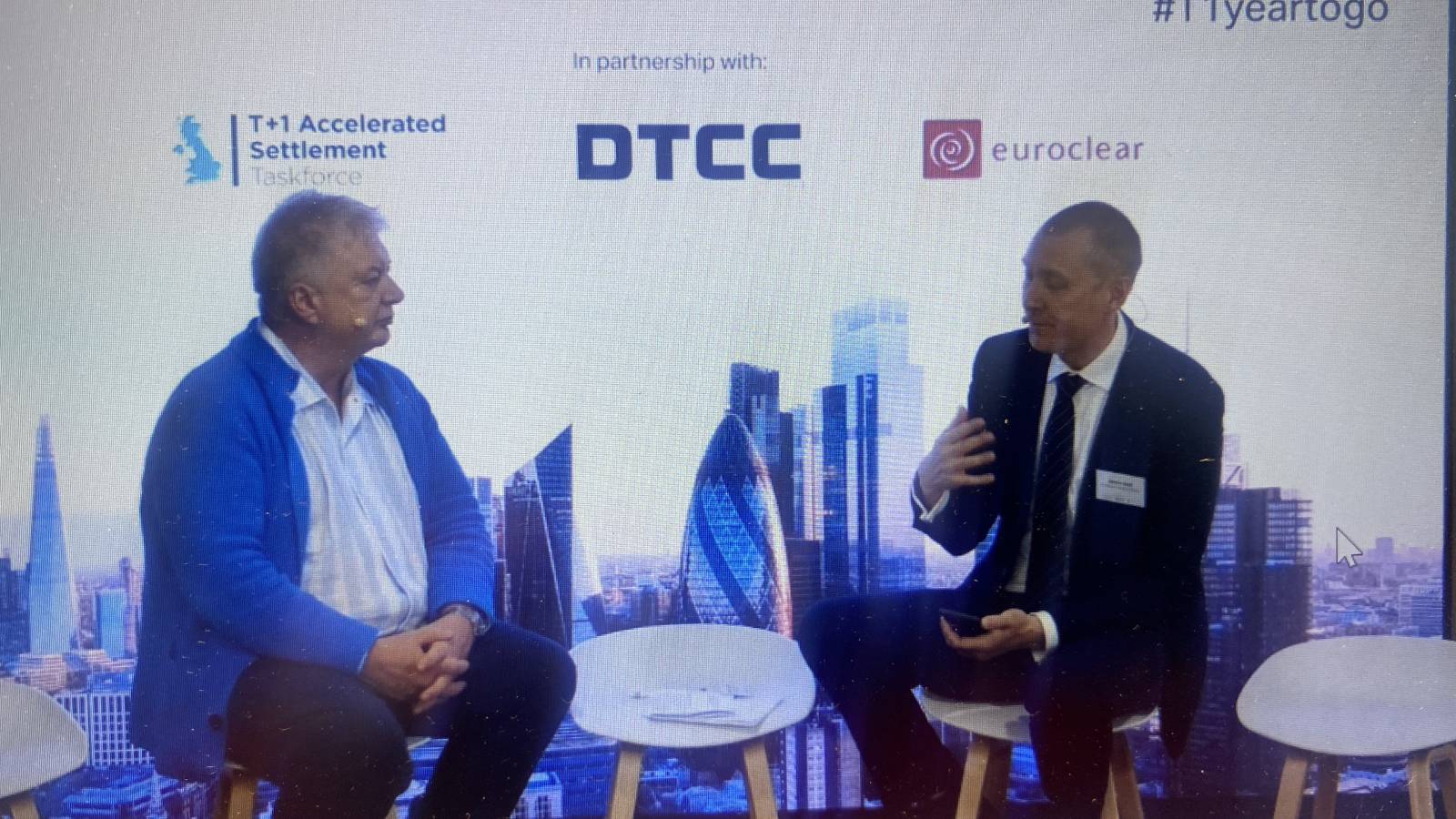



Nobody can truly predict the future, but four post-trade experts gave it a good shot at the ECSDA Post-trade Conference 2025. In the panel titled “Expert insights: financial infrastructures of the future – a roadmap for transformation”, they discussed the business requirements and technological innovations necessary for building the next-generation ecosystem of financial market infrastructures (FMIs).
First to take the mic in the panel, Olga Jordäo succinctly captured the current state of the post trade sector in a single sentence: “Everything has to change for nothing to change.”
To bring home her point, the CEO of Euronext Securities Milan and Porto, head of CSD Business Operations adds, “Central securities depositories are and must remain the backbone of market stability and resilience.”

The issue of EU fragmentation has been around for a long time, but so have the solutions – Jordäo named TARGET2-Securities (T2S) and the Central Securities Depositories Regulation (CSDR) as examples. The problem? “For years, nobody put these ingredients together and found the right recipe. The kitchen was full, but the meal was never served,” she says.
Clear out the spiderwebs
But “finally, things are starting to move” – by that, Jardäo meant Euronext’s move to consolidate settlement into a single CSD. Although the firm has described the move as one that will create “a true European solution”, it caused much debate within the industry when it was first announced earlier this year. “Vertical integration does not mean creating silos. It’s about fostering integration without breaking liquidity tools,” Jardäo argues.
“We all accept the issue of fragmentation and the benefits of reducing it, but what’s the best way to get there? Is it by continuing to connect 27 markets to each other? In theory, that sounds tempting… But let’s ask ourselves if building such a spiderweb is the most cost-effective thing to do, regardless of how much business actually flows through these links.”
Converge to one
To her, T2S is an elegant solution to the problem. “Instead of dozens of bespoke bilateral connections, T2S provides one common platform where all participating CSDs interact under harmonised standards. This is how we achieve interoperability without recreating inefficiencies,” she says. “The fact that different securities are issued and settled through different CSDs does not, in itself, fragment the settlement and custody of these individual securities, as long as all trades ultimately converge to the same point of final settlement and custody.”
“Competition can drive efficiency providing that the right conditions exist – competition supported by the adoption of T2S by all EU CSDs is the mechanism through which the current fragmentation and inefficiencies can be addressed,” Jardäo concludes. “the question is not whether we connect Europe. The question is how we do it.”
The tech focus
Up next on the podium, Isabelle Delorme, global head of Product Strategy and Innovation at Euroclear Belgium, France, and Netherlands focused her speech on artificial intelligence (AI) and data management.
“The common responsibility that we have is to make sure that we don’t recreate a fragmented world – a world with too many specificities and exceptions and so on – and that we take advantage of having new assets and new technology in our hands to make sure that we create from scratch a world that is superior.”
Sharing is caring
Backing Delorme’s focus on technology, Dimitri Pattyn, deputy director general of Market Infrastructure and Payments, European Central Bank (ECB) brought up the bank’s Appia initiative. The objective of the initiative is to explore new concepts, such as a European shared ledger, to create a harmonised and more efficient financial ecosystem in the region.
“Between a world where there could be a network of private ledgers and one single unified ledger, we believe that there is room for shared ledgers, where the ledger would be interoperable with other ledgers and those ledgers would be also unified. We believe that it would lower the cost of the infrastructure and mitigate inefficiencies stemming from fragmentation,” Pattyn says. The aim is to avoid “going back to a situation where there is more fragmentation than before, where DLT platforms aren’t merging”.
Hand in hand
Francisco Bejar Nuñez, co-head of Custody Operations at SIX, shares Delorme’s and Pattyn’s belief in the transformative powers of technology. “(AI) is not only about process optimisation. It’s also a driver of resilience and scalability.” Optimised processes, combined with DLT, T+1, and AI, could result in “a natural transition to a 24/7 cost-based operations model”.
Pattyn concludes, “Everything seems to indicate that DLT-based solutions are likely to keep evolving, but that there will be a long coexistence with legacy-based infrastructures.”
The ECSDA Post-trade Conference 2025, held on 18 November 2025, is hosted by the European Central Securities Depositories Association (ECSDA). Follow our coverage in the coming days on the site.