









DEEP LOOK | How sturdy are market infrastructures looking and what are their biggest worries? A week before the war broke out, Eurex hosted its Derivatives Forum, where experts looked to answer these questions and take stock of their resilience and stability in a changing environment based on previous shocks. We look at expert insights from those discussions and how they map with present realities.
PERSPECTIVES PLATFORM | Market Infra March • Check out our monthly editorial themes and deepen your insight!
March 2026 sees us speaking with the industry about market infrastructures; find the insights indexed here. For the index of past and planned themes, check the new Perspectives Platform hub page!
March opened with war. Markets jolted without regard for the operational rhythms of financial infrastructure. Each geopolitical shock brings a familiar three‑layered impact. First, the human tragedy. Second, the geopolitical and economic fallout, from sanctions to supply‑chain disruption. And third, the market‑infrastructure stress test: the surge in volumes, the scramble for liquidity, and the heightened cyber threat environment.

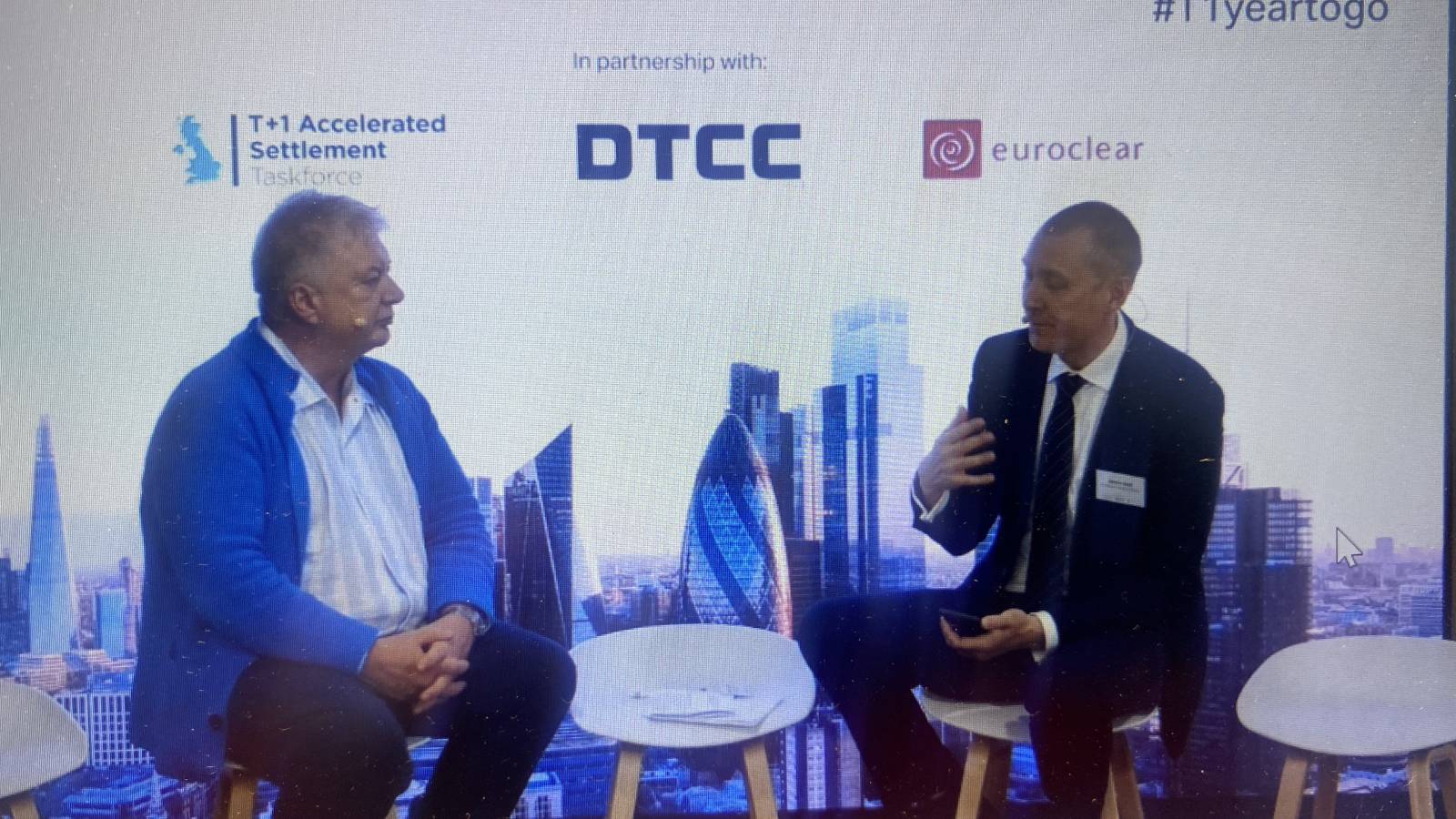
The comments that emerged from last week’s Eurex Derivatives Forum could not be more pertinent given the conflict that has broken out this week. Market infrastructure leaders and market practitioners had gathered to discuss how clearing houses prepare for the unthinkable while still pushing ahead with innovation. The conversation – featuring Eurex Clearing’s chief risk officer (CRO) Dmitrij Senko, DTCC’s group CRO Timothy Cuddihy, and CCP Global CEO Teo Floor – revealed an industry that has accepted conflict as a recurring feature of the landscape, not an anomaly.
Volatility as the first shockwave
When conflict breaks out, volatility is the first and most visible shock. Markets gap, spreads widen, and liquidity thins. For market infrastructures, this translates into intraday margin calls, rapid repricing, and the need to maintain stability in the face of unpredictable flows.
“During times of stress, the ability of the market to intermediate definitely does struggle,” said Cuddihy, noting that April tariff‑driven volatility in 2025 offered a preview of what conflict‑driven markets look like.
Eurex’s Senko noted that anti‑procyclicality measures have become essential in such moments. “Margins remained pretty calm… our margins were not posing concerns,” he said, contrasting Eurex’s experience with other CCPs that were forced to increase margins during the same period. The message was clear: in a world of geopolitical shocks, margin stability is a competitive advantage.
Volatility helps, and the plumbing holds
Eurex told us the heightened geopolitical tensions are fuelling uncertainty and volatility in the financial markets and prompting market participants to manage their risks, which is directly reflected in its trading volumes. “Even in these times of high activity, our systems ensure stable and orderly trading. The reliability of our infrastructure is proving to be a crucial anchor for the stability of the financial markets.”
A complementary perspective came from the leader of a CSD, speaking from the settlement layer – one that underscored the resilience of Europe’s post‑trade infrastructure.
“Yes, volumes have been more volatile,” he said. “Perversely, this is helping us, both on the exchange side and also on the post‑trade side, because settlement volumes, trading volumes, clearing volumes are high.”
But the more striking point was what didn’t happen.
“What we’ve seen this week is not really trumping last year,” he said. “Even with these peaks of extreme geopolitical horror, the systems work perfectly.”
“It’s not like one CSD couldn’t cope with all the volumes. Everything is working as expected. That’s the resilience of our systems.”
He noted that markets still assume the conflict will remain contained. “If this becomes a broader conflict… then we will see even bigger spikes,” he warned. But even then, “from an FMI point of view, we will be fine.”
The past decade, he said, has been a live stress‑testing environment: COVID, tariffs, political shocks. “We’ve invested significantly in tech and upgrading our platforms. I’m sure that’s been the case across the industry.”
Cybersecurity: The second shockwave
If volatility is the first shockwave of conflict, cyber escalation is the second. Floor described a shift in attacker motivation that has become increasingly visible over the past decade. “Much of the fear is not that somebody is trying to make money… but really just trying to break things,” he said. State actors and their proxies now play a central role in the threat landscape, and their objectives are often destructive rather than financial.
This creates a structural imbalance. “Private sector institutions… can’t purely themselves be up against a well‑funded, extremely proficient state actor,” Floor warned. As a result, governments have become more involved in cyber‑resilience frameworks, from intelligence sharing to on‑site support.
Cyber preparedness is no longer about building higher walls but about assuming breach and rehearsing recovery. In conflict‑driven markets, stability depends on CCPs maintaining operational continuity even under cyber duress.
Cloud, concentration risk and the shift toward resilience
Conflict also exposes vulnerabilities in cloud concentration. Senko was clear: “Single cloud is not sufficient. There should be fallback, either another one or on‑prem.” But multi‑cloud is not a panacea. “As long as there’s some technical layer which is common… that’s also a potential source of weakness,” Floor warned.
Across the panel, a consensus emerged: efficiency is no longer the dominant objective. “Efficiency is good, but resilience is better… it’s less cost efficient, but more resilient,” Senko said. The industry is rebalancing toward redundancy, diversification and operational depth.
Preparing for a world of recurring shocks
The Eurex Derivatives Forum made one thing clear: conflict is no longer an external event that occasionally disrupts markets. It is a recurring stress test for the global clearing ecosystem. CCPs and CSDs must now operate with the assumption that volatility, cyber aggression and geopolitical fragmentation are structural features of the environment.
Their resilience will depend on robust margin frameworks, cyber‑defence coordination, diversified infrastructure, transparent client communication and the ability to scale during volume spikes. Innovation continues — not despite conflict, but because the market demands it.