










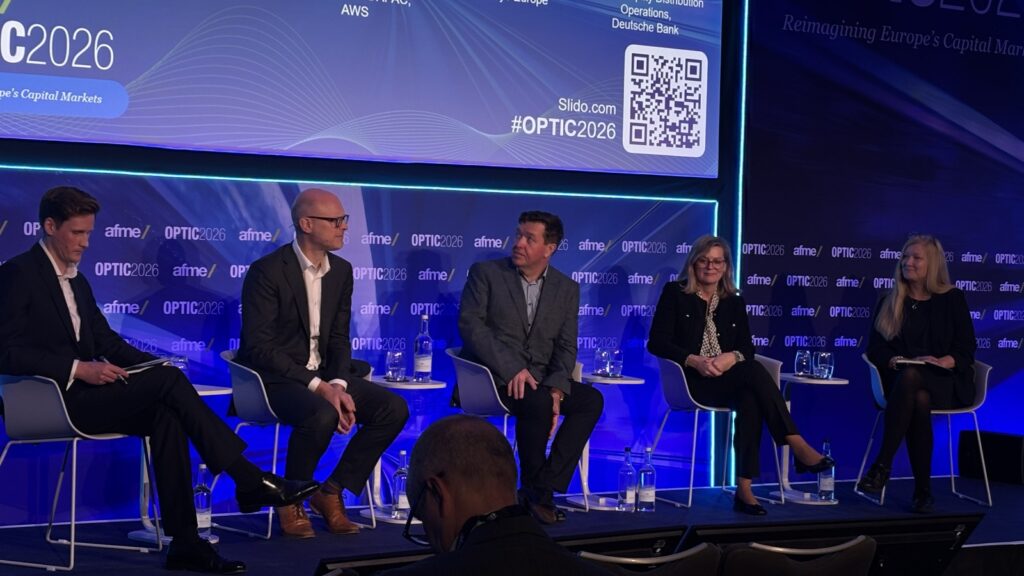
With five years to rethink how banks operate, panellists at Optic 2026 identified AI, simpler processes and closer collaboration between operations and technology teams as key factors shaping the road to 2030. But adopting new tools without rethinking existing workflows risks limiting their value.
The session Banks’ Operations in 2030 brought together representatives from Barclays Europe, Citi, AWS and Deutsche Bank to examine how banks can adapt while maintaining controls, managing risk and meeting regulatory requirements.
AI is likely to have the most immediate impact on operations, compared with distributed ledger technology (DLT) and quantum computing. “It’s 100% going to be AI,” argued Tiina Winnan, head of equity distribution operations at Deutsche Bank, pointing to the technology’s existing use in the industry.

Aileen McCormack, head of operations at Barclays Europe, urged banks to focus on outcomes rather than simply automating existing processes. “What we need to do now is think about the outcomes,” she explained, adding that firms should question the complexity of legacy workflows before applying new technology.
Stephen Martin, AWS’s head of financial services compliance and security for EMEA and APAC, highlighted AI’s potential to remove low-value decisions from operational workflows, while emphasising the importance of data. “Data is absolutely fundamental to getting AI-enabled workflows working properly,” he noted. He also pointed to the growing role of data stewards and the impact of AI coding tools, which are making in-house development faster and cheaper. Banks must still weigh the options of building or buying solutions.
Redesign workflows
For Nigel Cobb, Citi’s head of process engineering for market operations, AI should enable banks to redesign workflows rather than merely automate existing tasks.
As automation reshapes entry-level roles that have traditionally helped employees develop product expertise, upskilling and talent development will become increasingly important, Winnan stressed.
McCormack highlighted the importance of platforms that can accommodate new technologies and products while interpreting regulation correctly and retaining human judgement.
The discussion also highlighted fragmented supervisory approaches as a potential obstacle to implementation. Panellists emphasised that technological progress must be matched by sound controls, collaboration and clear business outcomes.