

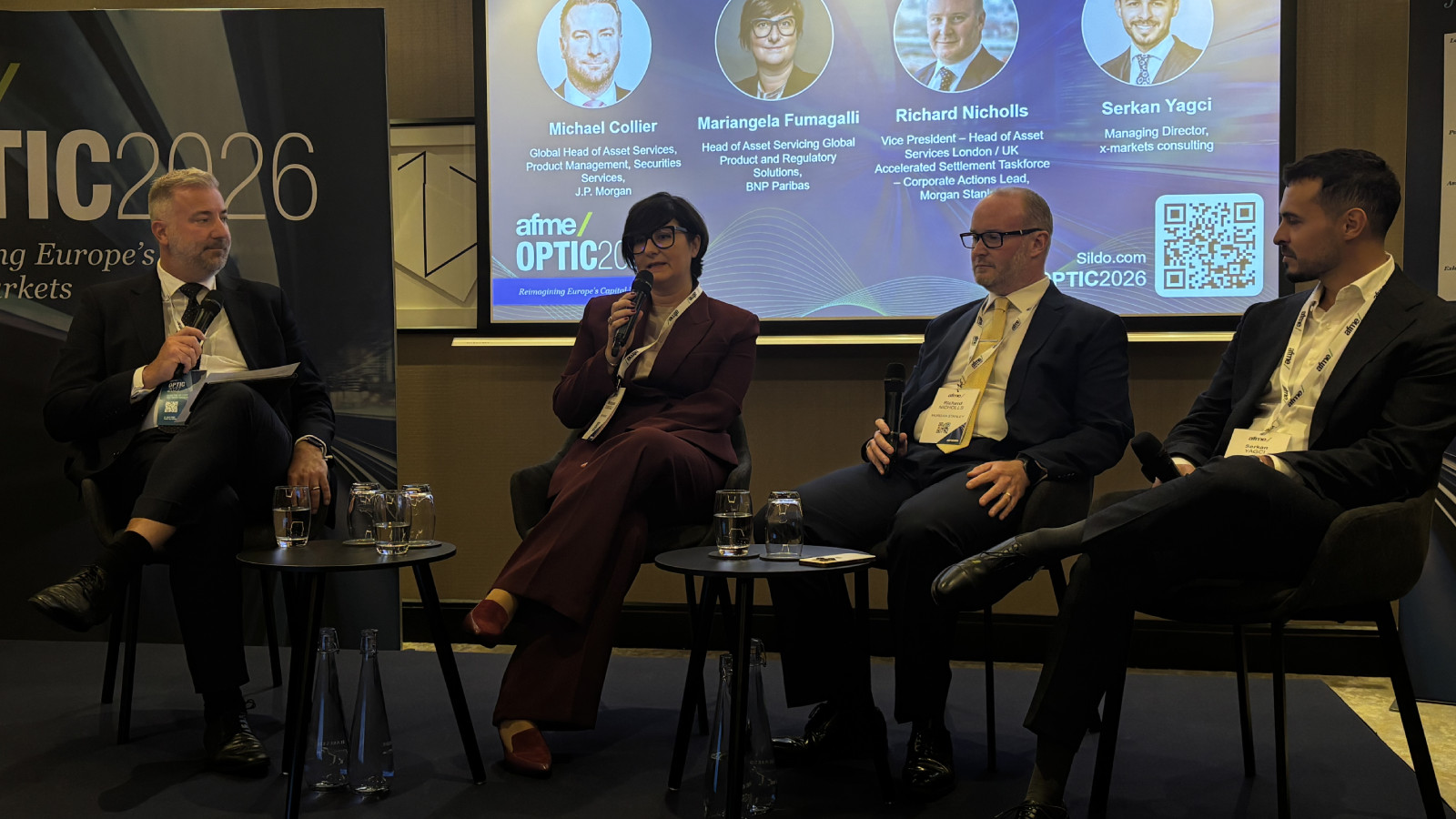







In managing data quality, the old axiom of garbage in, garbage out holds true, said Doug Carlson, senior vice president and head of Global Payments Product Management at PNC Bank. In the session titled “Mastering data quality: the key to unlocking ISO 20022’s full potential” at Sibos 2025, four experts took to the stage to discuss how data can be optimised for success.
“You have to make sure that what you are receiving is good quality,” Carlson emphasises. He revealed that PNC Bank is utilising data lineage tools to classify and categorise metadata appropriately as well as to document all integrations throughout the chain. “It’s important to maintain data integrity when the data comes in through the front door and maintain it throughout the ecosystem – really through the lifecycle of the transaction.”
Karyna Hutarovich, vice president at Deutsche Bank, wants to see a more proactive approach to data quality management. “Good data is not just about avoiding errors. It’s about enabling smart operations,” she says. “Not all bad data gets rejected. Some of it slips through and it will quietly slow your performance time or lead to downstream issues… The proactive monitoring of data is important. Make sure that you have established a robust monitoring process within the institution. There are several ways you can do that – you can build a solution in-house or you can leverage industry solutions.”

No pain, no gain
Quality, of course, comes with challenges. Hutarovich shares, “One of the first hurdles that we encountered was cleaning up our own legacy systems. They had evolved over the years and were shaped by custom structures and client specific formats so transitioning to ISO 20022 was really about going back to the foundations – rethinking the architecture, rethinking the data flows, and essentially started fresh. It was not really just migration. It was a deep renovation.”
Carlson believes that challenges become less duanting if not tackled alone. “We’ve been doing as much peer-to-peer testing as possible and it’s been very helpful, not only to ensure that the messags we are sending out into the world are being processed appropriately, but also to identify any issues from a production standpoint and to prepare for the possiblity of developing automated rules that we could enact so as to minimise manual repair and the impact to our operations.”
An opportunity
Susan Yang, general manager of International Payments and Network Management at the Commonwealth Bank of Australia (CBA) encouraged the audience to look at ISO 20022 implementation as a catalyst to transform their technology stack. “We (at CBA) have used this opportunity to roll out fully cloud-enabled systems end-to-end. We have rebuilt all the digital channels in the interface to enhance the customer user experience and bring real value to the customers.”
Sibos 2025 plays out in Frankfurt from 29 September to 2 October, with about 12,000 registered delegates. We are there, overview our coverage here.