








Three-quarters of OPTIC delegates want mandatory interoperability across all European cash equities CCPs. Not one voted for the status quo.
European market participants have sent a clear message to policymakers. At AFME’s OPTIC 2026 conference, 76% of delegates polled said the best outcome of the Market Integration and Supervision Package (MISP) proposals would be mandatory full interoperability across all European cash equities CCPs.
Another 17% would limit the mandate to markets that already support preferred clearing. A further 7% would keep preferred clearing but require interoperability between preferred CCPs. Nobody voted for keeping current arrangements.

The panel of banks and CCPs agreed with the room. Cate Grant, global head of market solutions at Goldman Sachs, said: “It’s been clear from the AFME community that it’s what we as a market want. Any kind of interim step, rather than full interoperability, just puts more onus on the market for interim technical changes, when really you should be grasping this window of opportunity. We don’t know when the next window will be.”
Tim Beckwith, head of commercial and business development at Cboe Clear Europe, said he was “very happy” with the result. Cboe has argued publicly for mandatory interoperability across Europe, although he accepted that smaller markets with little international participation may not need it. He pointed out that “two significant market exchange groups in Europe” are still not embracing competitive clearing.
Corina Scott, head of clearing product and business development at SIX, said the model has a track record: “Interoperability has operated reliably for more than 20 years. If it’s a practical way to reduce market fragmentation, increase client choice and improve market efficiency – let’s leverage it.”
The margin trade-off
The moderator, Martyn Nott, global head of network management at Bank of America, raised the cost: “Increased CCP interoperability is often associated with an increase in margin requirements. The math says that’s what happens.”
Grant argued the trade-off was worth it. Full open access would let firms consolidate their activity at fewer CCPs. “We think full interoperability would dramatically reduce our clearing and settlement costs on a day-to-day basis,” she said.
An audience member asked how default funds would work in a fully interoperable market. Beckwith said they would be unaffected. CCPs do not contribute to each other’s default funds, and inter-CCP exposures are covered by a separate collateral pool. He called it “a highly regulated model” that is “very difficult to change overnight.” Scott suggested later margin call deadlines as one way to bring margin levels down.
T+1 adds urgency
The EU’s move to T+1 settlement on 11 October 2027 is adding pressure. Grant said “a huge swathe” of institutional OTC and prime brokerage flow in vanilla cash equities is still not centrally cleared in Europe. In the US, the same segment gets 98% compression.
“As we move into a T+1 world, we need to get more of our cash equities into clearing,” she said. She described the obstacles as “a behavioural and structural challenge”, not a technical one. They include allocating settlement between executing and prime brokers, and repapering some clients.
Nott warned that T+1 could also compete for budget: “In some respects, T+1 is a new Brexit in terms of a reason to spend your technology dollars on something else.” Beckwith said some clients are instead using their T+1 programmes to expand into new clearing services. One example is securities financing clearing, which Cboe Clear has recently extended to fixed income and US securities. Nott said Bank of America could bring “not insignificant volume” to that service.
Digital collateral, not atomic settlement
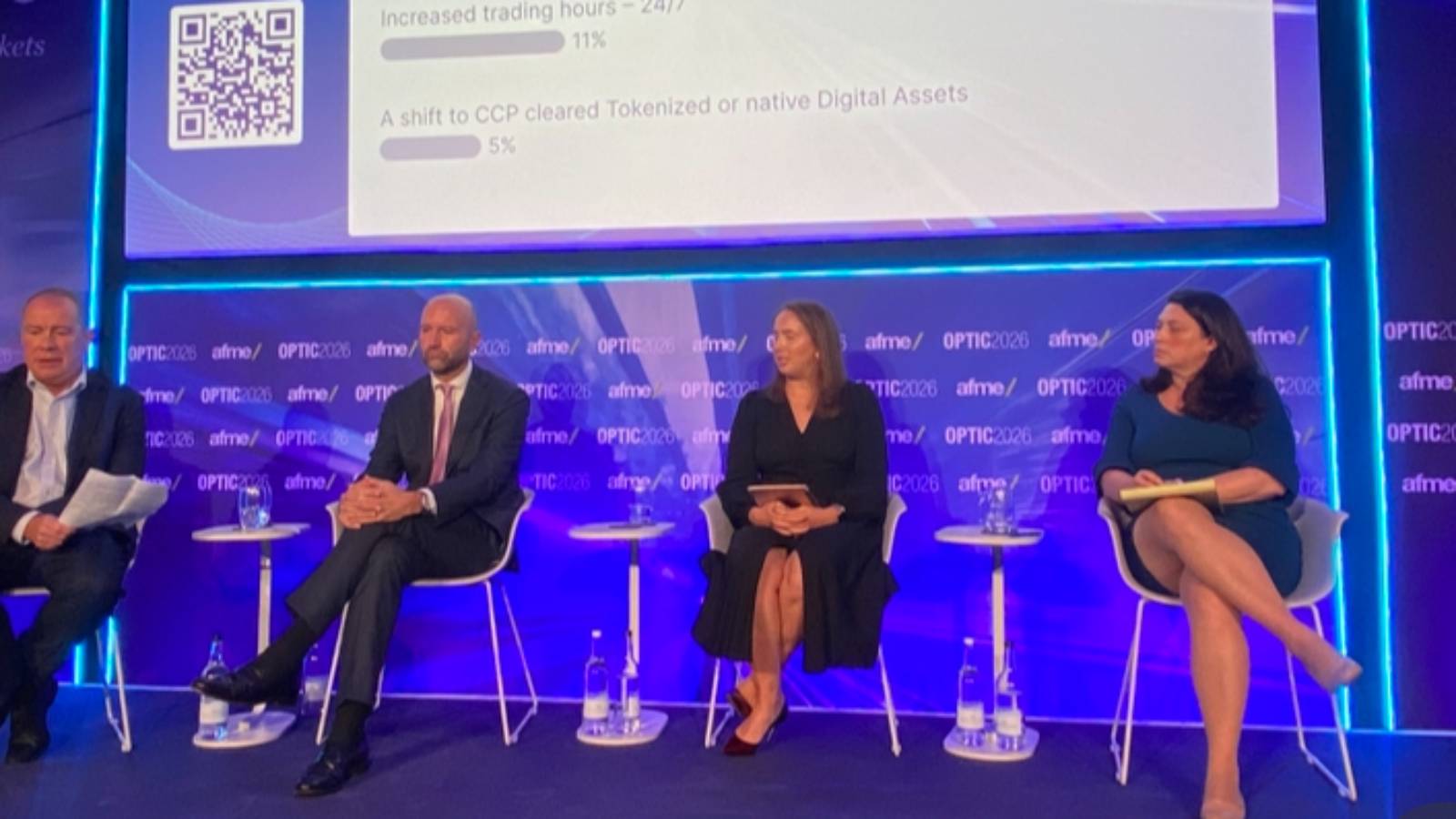
A second poll asked what would have the greatest long-term impact on the sector. Digital assets as collateral for CCP margin led with 51%. Atomic settlement with no CCP got 32%, 24/7 trading 11%, and CCP-cleared tokenised assets 5%.
Grant called tokenised collateral “near-term rather than long-term” and “a real game-changer for clearing brokers,” because it would allow dynamic margin posting. Beckwith did not accept that atomic settlement would make CCPs redundant: “Let’s not forget what we’re here for, and that doesn’t change.”